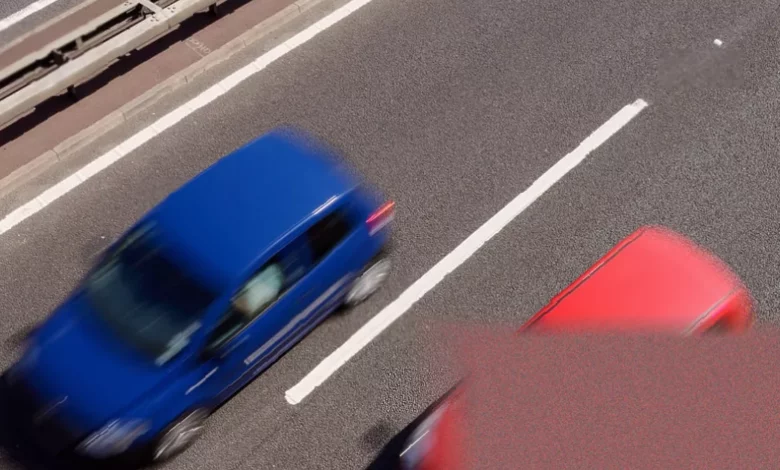
For motorists who have ever felt a sense of doomed inevitability after overtaking a slower car, only to find it looming in the rear-view mirror at the next red light, mathematics now offers a definitive explanation. Far from being a paranoid fantasy, the phenomenon has been modelled and proven, revealing the precise traffic conditions that turn a fleeting lead into a frustrating reunion.
The mathematics of the catch-up
The principle, dubbed “The Voorhees Law of Traffic” by its creator Dr Conor Boland of Dublin City University, analyses the interaction between two cars travelling at different speeds and a set of traffic lights operating on a fixed-time cycle. The name is a playful nod to the relentlessly stalking horror film antagonist Jason Voorhees, whose victims never truly escape.
Dr Boland’s model, published in the journal Royal Society Open Science, breaks down what happens when two cars on a single-lane road approach a traffic light. The change in spacing between them can fall into one of four categories: it can increase, stay the same, decrease somewhat, or be eliminated entirely. Which outcome occurs depends on a specific set of variables: the colour of the light as each car arrives, the light’s duration, the time advantage of the faster car, and the total length of the traffic light’s cycle.
The crucial finding is that, when averaged out, the potential gains and losses in spacing balance exactly. This means that, at a single traffic light, the lead one car has over another is statistically likely to remain unchanged once both have passed through. The slower car’s reappearance is not a foregone conclusion at one isolated junction.
However, the dynamic shifts dramatically in urban environments with a succession of independent traffic lights. Here, the eventual catch-up of the slower car at at least one set of lights becomes statistically near-certain. As Dr Boland explains, this is because the probability of the slower car *never* catching up requires multiplying the probability of no catch-up for each individual light. With every additional set of lights, the overall chance of never meeting again diminishes drastically, making a reunion highly probable over a series of junctions.
Why it feels so inevitable
If the advantage is often neutralised at a single light and only becomes probable over multiple lights, why does the experience feel so personally persistent? Dr Boland points to a quirk of human psychology. In his paper, he notes that “recurrent encounters are known to be disproportionately salient in human perception, particularly when they follow an attempted separation or avoidance.”
Put simply, drivers are far more likely to remember and be frustrated by the times the car they overtook catches up, while disregarding the many times it does not. This effect is compounded by a general negativity bias, where annoying or frustrating events create a stronger mental imprint than neutral ones. The feeling of inevitability is, therefore, a powerful cognitive illusion built on selective memory.
Road safety and the futility of the rush
The research carries clear implications for road safety and driver behaviour. Dr Boland states that the results suggest speeding past others does not necessarily confer a meaningful or guaranteed time advantage, especially in towns and cities. The model underscores a counter-intuitive truth: aggressive overtaking to gain a few car lengths is often rendered pointless by the very infrastructure designed to regulate traffic flow.
The work has been welcomed by independent experts. Kit Yates, a professor of mathematical biology and public engagement at the University of Bath, said it was good someone had sat down to model this common experience. “As the old adage goes, ‘all models are wrong, but some are useful’ and I think this one is definitely useful to explain why slower cars can often catch up with quicker ones,” he said.
Professor Yates, who was not involved in the study, did note its necessary simplifications, such as assuming constant speeds between lights and not accounting for acceleration or deceleration at the signals themselves. Nonetheless, the core probabilistic insight stands.
Dr Conor Boland, whose primary research at Dublin City University is in materials science and bioelectronics, demonstrates through this study how mathematical modelling can cast new light on the mundane rituals of everyday life, revealing the hidden patterns behind a common driver’s grievance.