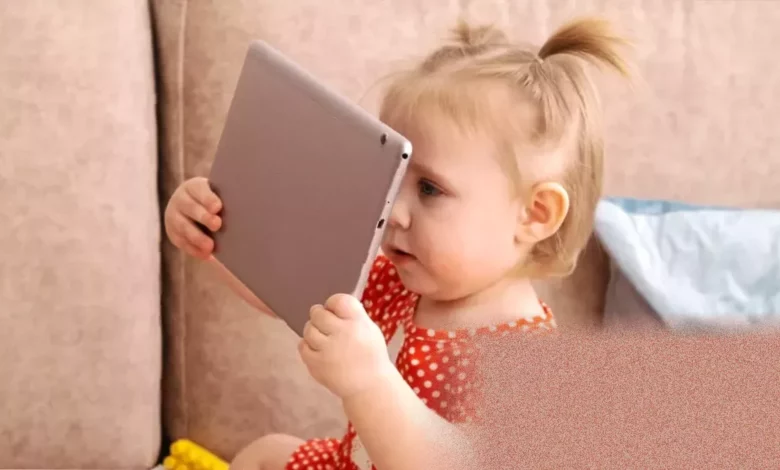
The vast majority of nine-month-old babies in England are being exposed to screens on a daily basis, new national research reveals, as experts and ministers scramble to provide parents with clear guidance in an increasingly digital world.
A study by the Education Policy Institute (EPI), drawing on data from 8,000 families in the nationally representative Children of the 2020s study, found that 72% of infants at nine months experience some daily screen time. The average daily exposure for these babies is 41 minutes, but a small, significant group of 2% are in a “heavy use” category, watching for more than three hours each day.
The Screen Time Landscape for Babies
Contrary to what might be expected, the research found parents across different income and education levels made broadly similar choices for their nine-month-olds when it came to allowing any screen time at all. Where differences emerged was in household structure. Babies with no siblings were far more likely (80%) to have screen time compared to those with four or more siblings (57%). Infants in single-parent households also had a higher average daily screen time of 47 minutes, compared to 39 minutes for those in two-parent homes.
The study identified a tangible trade-off for the heaviest users. Those infants watching over three hours daily were “significantly less likely” to experience regular enrichment activities like being read or sung to, or going on trips outside. For example, 80% of babies with no screen time went on outdoor trips daily, compared to 60% of those in the heaviest use group.
However, the EPI researchers stress that the picture is nuanced. They found that parents of babies watching up to two hours of screen time were actually more likely to report daily activities like pretend play, turn-taking, and singing compared to those with less or no screen time. The likelihood of daily reading only decreased once screen time surpassed two hours.
Escalating Exposure and Developmental Concerns
The snapshot at nine months is just the beginning. Separate Department for Education (DfE) research from the same Children of the 2020s study, focusing on children at age two, shows screen time escalates dramatically. By that age, 98% of toddlers watch screens daily, averaging over two hours (127 minutes) per day.
This later research reveals a much stronger link to social and economic factors. At two years old, children from lower-income families had nearly double the screen time of those from higher-income families, and similar disparities were linked to parental education levels and ethnicity. Children whose primary caregivers had symptoms of depression also had significantly higher average screen use.
This rise in exposure coincides with peak concerns from health professionals about development. The World Health Organization recommends no screen time at all for children under two. A body of research, including the DfE’s own analysis, links higher screen use to poorer language development. Their study found two-year-olds in the highest screen time group (averaging around five hours a day) could say, on average, 53% of a set of test words, compared to 65% for those in the lowest group (averaging 44 minutes).
Experts have also drawn connections to broader issues. High media use in young children has been linked to lower integrity in the brain’s white matter, which supports executive function and language. Excessive screen time is strongly associated with behavioural difficulties; two-year-olds with the most screen time were more than twice as likely to have some emotional and behavioural problems than those with the least. Background TV has also been found to negatively affect attention, cognitive development, and executive function in under-fives.
A Shift in the Conversation and Forthcoming Guidance
In light of these complex findings, experts are calling for a more sophisticated public conversation. Dr Tammy Campbell, director for early years at the EPI, argues that screen time and a healthy childhood “are not necessarily mutually exclusive”. She said: “A large part of the conversation needs to shift from ‘how much’ to ‘what,’ and ‘why’. It’s about how and when a screen is being used for shared, interactive play, or for passive viewing.”
This shift is central to the first official government guidance for parents on screen use for under-fives, which is expected imminently from the Department for Education. The guidance is being developed by a panel co-chaired by the Children’s Commissioner for England, Rachel de Souza, and paediatrician Professor Russell Viner.
A DfE spokesperson said: “Parents have told us they want clear, practical and non-judgmental advice on screen use for under-fives as they raise children in a digital world.” Ms de Souza added that the guidance will offer “clear, trustworthy advice, giving parents confidence when managing how their children see screens,” acknowledging that screens are now an ingrained part of everyday family life.
The challenge, as outlined by the research, will be balancing realistic advice with the stark evidence on overuse. While organisations like Health Professionals for Safer Screens recommend no screens before 24 months except for video calls, the data shows that for the vast majority of modern families, that ideal is already a distant reality. The new guidance will attempt to bridge that gap, focusing on context, content, and the quality of interactions both on and off the screen.