Imagination is a vital, life-saving faculty, not merely a fleeting fancy of childhood. When a three-year-old girl on a windswept beach rises to her feet and stares at a giant striding past the horizon, she is not playing in the way a kitten plays. She is doing something far more profound: she is nourishing a capacity that, if sustained, can empower her to dream her way out of despair, to envision futures she might otherwise never reach, and to hold onto hope in a world that too often demands she let it go. The tragedy, as Australian teacher and author Brendan James Murray argues in his new memoir Childhood, is that almost all children will lose this faculty by their mid-teens, or have it dimmed nearly out of existence. And the culture, from the classroom to the living room, accepts this loss as an inevitability of growing up.
The Cultural Devaluation of Imagination
The evidence of this cultural surrender is everywhere. In Western societies, the word “imagination” is treated as the property of the very young; it disappears from Victorian education department curriculum documents well before children reach high school, and it rarely appears much before that. The connotations of the word in adult contexts are at best ambivalent, at worst outright negative. Being called a “dreamer” is rarely a compliment; the phrase “in one’s dreams” is used to mock not only the hope but the very act of building imaginative constructions. This language is part of a wider, ostensibly pragmatic effort to wrench people back to what Western society calls “the real” and, more importantly, “the useful.”
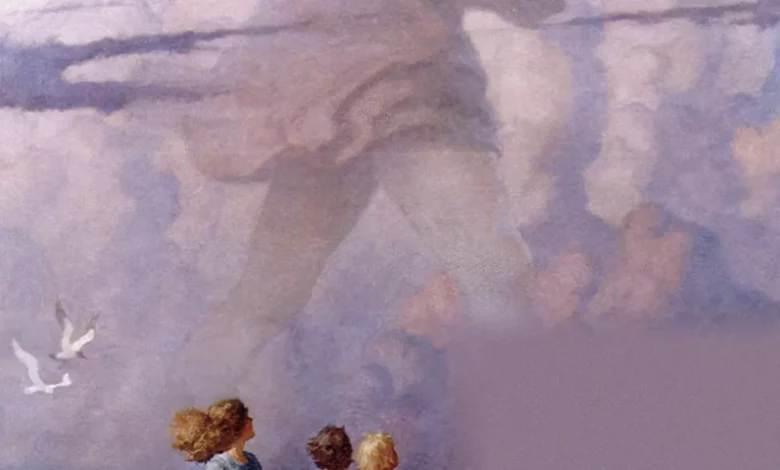
Murray, who draws on his experience as an English and Literature teacher and his own working-class upbringing on Victoria’s Mornington Peninsula, uses the American artist NC Wyeth’s 1923 painting The Giant as a poignant emblem of this loss. The painting was commissioned by the Westtown School as a memorial to William Clothier Engle, a classmate who died young. It shows Wyeth’s five children at the waterline, with Engle represented by a young man in a white hat in the distance. The low angle of the canvas emphasises the giant’s immensity; all the children’s faces are turned away, so that they become anyone we might imagine. The scene is suffused with a sense of nostalgic impermanence, as if the moment of wonder is already slipping away. Art critics have noted Wyeth’s technical mastery – the way shadows create a three-dimensional effect and blur the line between reality and myth – but for Murray the painting captures something deeper: the knowledge that such imaginative vision is treated as a brief, fragile episode, to be outgrown.
Historically, the concept of childhood as a distinct period of innocence, freedom and imagination only emerged strongly in the mid-18th century and was cemented in the Edwardian era by children’s literature that offered fantastical worlds. Before that, children were often depicted as mini-adults. Yet today, even as we romanticise that brief window of wonder, we do little to protect it. Research suggests that about 51 per cent of children begin to lose their sense of wonder by the age of six. The decline in divergent thinking – the ability to generate multiple solutions to a problem – is even starker: 98 per cent of three- to five-year-olds demonstrate this hallmark of creativity, but only 10 per cent of 13- to 15-year-olds still show it.
Why Imagination Matters
These losses are not trivial. They are, in Murray’s words, “one of the greatest invisible tragedies in the lives of children,” carrying them into adult lives of squandered potential or worse. Neuroimaging studies show that pretending recruits similar neural circuits to real behaviour; imaginative play stimulates connections, improves cognitive flexibility, and is linked to the default mode network that plays a role in creative thought. Imagination is the soil in which curiosity takes root and the foundation for innovation. It builds resilience, emotional regulation, empathy, and the ability to learn from imagined experiences.
Teachers know this instinctively. Murray describes how the most driven, successful and passionately engaged students are those who could imagine themselves – dream themselves – into their goals from a young age. A twelve-year-old who says she wants to be an archaeologist is not thinking about the profession abstractly; she is feeling the hot sand on her face, seeing the pyramids rise against an impossibly blue sky, envisioning the creaking mysteries of sarcophagi in firelit tombs. She is there. Without that imaginative capacity, speculative possibilities wilt. In a very real sense, loss of imagination is loss of hope.
Murray’s own childhood offers a counterexample. His grandfather invited him to dream about the smooth stones in his rock garden, but never with any expectations or demands. “I never had to find a better rock or attach a more convincing narrative to my latest discovery,” Murray writes. That free, untethered dreaming was profoundly nurturing. Today, when Murray’s own daughter discusses fairies, he does not see it as mere play. He sees her doing something vital – not just developmentally, but in terms of how she will live the rest of her life: as a person enthralled by wonder, possibility, impossibility, and open to all the joys such things offer.
How Schools Stifle the Dreaming Mind
Yet the modern education system, particularly in countries such as the UK and Australia, is built on the assumption that learning must be measured. This is the arena where imagination is most systematically damaged. Murray, who teaches English and Literature to teenagers, argues that the demand for products and assessment items manifests almost instantly whenever a child shows signs of imaginative engagement. An English teacher might want the children to write about what they saw, so that their writing can be compared with past work assessed against similar criteria. An art teacher might ask them to paint their memory. In the paradigm of contemporary education, there is an almost pathological need for teachers to observe both the process and the product of student learning. Every child has an adult at their shoulder at all times, producing anxious self-consciousness and a constant second-guessing of what the assessor wants.
The introduction of criteria to evaluate whatever “create-ivity” emerges from these closely surveilled efforts is, Murray says, perhaps the most stifling and sanitised imaginative space conceivable. “Write a story, but it must follow the conventions of science fiction. Write a poem, but it must employ the poetic style of Emily Dickinson. Write a paragraph, but it must begin with a topic sentence. Must. Instruction; structure; walls and barriers and limits.” He points out that every criterion has a shadow criterion – all the infinite things the student cannot do. “In some sense, criteria are imagination’s opposite, its antonym. Give us what we want. Imagination blotted out by insistence on a specific product demanded by an authority figure. All the freedom of water poured into a concrete aqueduct.”
Murray does not argue that criteria should be dispensed with entirely; they can offer value by showing students where they are and how to progress. But when criteria are applied to everything, imagination is stunted. Worse, he suggests, teachers may actually be destroying what is there, nascent or not. This is not a marginal issue. In the UK, the National Curriculum has placed a greater emphasis on creative and cultural education since the 1999 NACCCE report “All Our Futures,” and initiatives such as the Durham Commission on Creativity and Education and the Arts Council England’s “Creativity Collaboratives” aim to integrate creativity across subjects. The government’s “Plan for Change” promises a new National Centre for Arts and Music Education and increased access to enrichment activities. Yet despite these efforts, arts GCSE entries in UK schools have fallen significantly, and many pupils miss out on sustained arts education altogether. The tension between high-stakes assessment and the free play of imagination remains unresolved.
The philosophical root of the problem may be economic. Murray observes that in an industrialised society, imagination for its own sake is not seen as serving capitalist needs. The word “creativity” has been embraced with unconscious passion precisely because it implies a tangible output – “a creator at least has something to show for their efforts … and perhaps something to hand over.” There is no sense that imagining can be a powerful end in itself. “To create implies external expectations (create for), especially in an educational context, and as soon as there are expectations, true imaginative freedom – the freedom to dream – begins to fade.”
The result is that even in the current era, which some term the “Imagination Age” – where curiosity and the ability to imagine what to do with information are paramount – education systems remain locked in a mindset of finding right answers rather than imagining better questions. The loss is not inevitable. Murray’s memoir, published in April 2026, is a plea to recognise that true imagination – untethered dreaming for the nourishment of the self – has become a radical act, as radical as trespass. It is a problem not only for teachers but for parents and for any adult seeking to explore their own potential. The children on Wyeth’s beach, their faces turned away, are not merely playing. They are engaged in something that, if cherished, could be life-changing and life-saving. To let it slip away is to surrender hope itself.