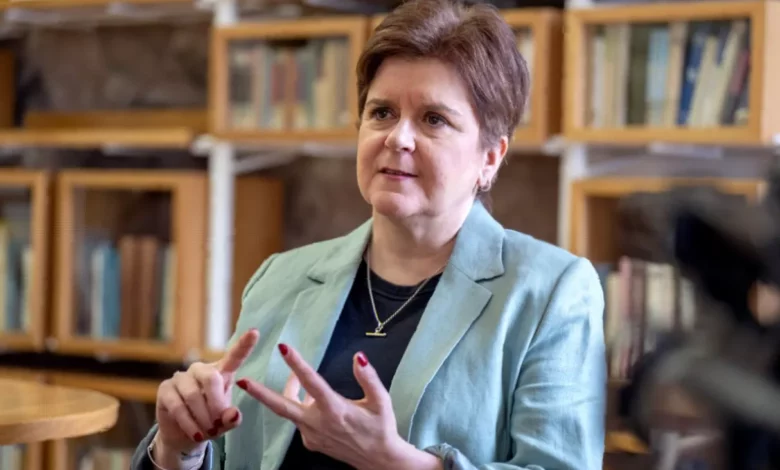
Nicola Sturgeon has dismissed as an “absolute falsehood” the notion that immigrants are responsible for the country’s problems, accusing figures such as Nigel Farage of deliberately stoking such a belief to divert attention from the real culprits – the proponents of Brexit.
“The problems of the country are real and big, but the idea that they are caused by immigrants is an absolute falsehood, fallacy, and it suits people like Nigel Farage to make people believe that, because actually the problems of the country are caused by people like him, the proponents of Brexit,” the then-First Minister said in the aftermath of the 2021 Scottish Parliament election.
Farage, a leading figure in the campaign to leave the European Union and later a prominent voice within Reform UK (the rebranded Brexit Party), has built a political platform on limiting immigration and asserting national sovereignty. Sturgeon’s remarks directly challenged that platform, suggesting the former UKIP and Brexit Party leader had a vested interest in framing migrants as a source of national difficulty in order to obscure the consequences of the vote he championed.
Her comments came against the backdrop of an election in which Reform UK did not win a single seat, while the SNP secured a fourth consecutive term as the largest party with 64 out of 129 Holyrood seats – though they fell narrowly short of an overall majority. The Scottish Greens, who share the SNP’s goal of independence, won eight seats, giving pro-independence parties a combined majority of 72. The election also saw a record turnout of 63.5 percent, the highest ever for a Scottish parliamentary vote.
Brexit, not immigration, as the root of the problems
Sturgeon’s central argument was that the country’s real difficulties stem from the economic and social fallout of Brexit, not from people who have moved to Scotland. Scotland voted overwhelmingly to remain in the European Union in the 2016 referendum – 62 percent in favour of Remain – and the Scottish Government has consistently warned that leaving the EU would take a heavy toll. Official Scottish Government analysis, released during the Brexit process, estimated that the resulting trade barriers could reduce Scottish GDP by at least £4 billion in the long run, and that the economy, culture and society would all be poorer due to reduced migration and competitiveness.
By laying the blame at the feet of Brexit proponents, Sturgeon was drawing a direct line between the political choices made by figures such as Farage and the tangible harms – depressed trade, labour shortages in key sectors, and weakened public finances – that have since materialised. The 2021 election was held during the COVID-19 pandemic, adding another layer of strain, and the SNP’s manifesto focused both on pandemic recovery and on securing a mandate for a second independence referendum, which the party argued was necessary to protect Scotland’s interests outside the EU.
Immigration itself was a significant issue in that election. For the first time, legally resident foreign nationals – including EU citizens with settled status and refugees – were allowed to vote in a Scottish Parliament election. Reform UK’s platform at the time called for a freeze on non-essential immigration, the deportation of illegal migrants, and a broader “British citizens first” approach. Sturgeon’s rejection of the anti-immigrant narrative was therefore also a rebuke to the party’s core policy stance, which she framed as a deliberate misdirection.
Farage’s alleged motive and the shifting political landscape
Sturgeon’s accusation that Farage and other Brexit proponents “suit” themselves by blaming immigrants implies a calculated strategy: by stoking public anger toward migrants, they deflect scrutiny from the economic damage caused by leaving the European Union. The Brexit campaign itself leaned heavily on slogans about taking back control of borders, and Reform UK has continued that emphasis since its rebranding in January 2021.
While Reform UK failed to make an impression in the 2021 Holyrood election, more recent polling suggests the party’s message has gained traction. As of December 2025, polls indicate 18 percent of Scottish voters plan to use their constituency vote for a Reform candidate, and 17 percent for the regional list vote – a significant rise that could translate into a breakthrough at the 2026 Scottish Parliament election, with projections suggesting the party could win as many as 19 MSPs. Meanwhile, Scottish Labour has seen its vote share decline, with political observers noting that its messaging has struggled to cut through, and the SNP – though still the leading party – has weakened compared with its 2021 performance.
Sturgeon’s remarks, however, did not focus on these electoral shifts. Instead, she insisted that the country’s problems – whether economic stagnation, social strain, or political division – are not the work of immigrants but of those who championed Brexit. The Scottish Government’s own analysis, which warned of a poorer society from reduced migration, further undermines the claim that immigrants cause harm. In Sturgeon’s telling, it is the Brexit project itself – championed by Farage and others – that has inflicted the damage, and the scapegoating of migrants is merely a convenient smokescreen.