Preston Mill, the historic watermill in East Lothian, tells the story of rural life in the county during the 18th, 19th and early 20th centuries, according to the National Trust for Scotland (NTS). That story has just gained a new chapter: after roughly three decades of silence, the millstones are turning once more, thanks to a conservation project that has allowed the mill to grind grain again for the first time in about 30 years.
At the heart of the narrative is the mill’s role as a community hub. Historically, mills like Preston Mill were more than places to process grain; they served as meeting places where local people gathered to exchange gossip and information. The NTS aims to bring that aspect of rural life to the fore, showing visitors how the mill was central to the social fabric of East Lothian’s farming communities. Guided tours now offer insights into the demanding work of the millers — the heavy lifting, the constant battle against pests, the dust, and the ever-present threat of floods. An exhibition about milling and the lives of millers is housed in the visitor centre or the miller’s family cottage. Visitors can see and hear the milling machinery in action, and the site also offers ice cream, coffee, and seating with a view of the mill, plus a gift shop. English National Trust membership grants free entry.
Centuries of history beneath a Dutch-style roof
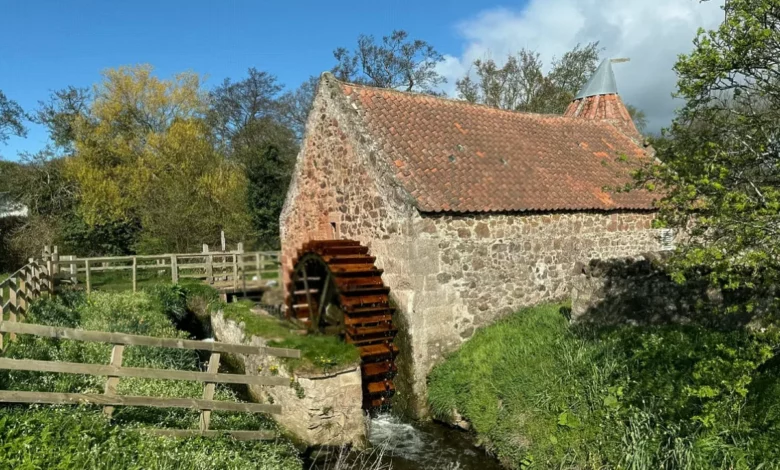
The mill’s historical scope is remarkable. While the current building dates from the 18th century, there are indications that a mill may have stood on this spot as early as the 13th century — meaning grain could have been milled here for around 800 years. The earliest surviving record of repairs to the building dates back to 1598. Preston Mill was the region’s last working watermill and operated commercially until 1959, producing oatmeal.
Architecturally, it is an oddity. The kiln is topped with a distinctive Dutch-style conical roof made of local volcanic stone and red pantiles — a feature that intrigues visitors and sets the mill apart. The building has a notable tilt caused by subsidence of the kiln, which is now supported by external stone buttresses. Flooding from the River Tyne has been a recurring hazard; a major inundation in 1948 saw water reach the roof, and flood markers are still visible on the outer wall. The waterwheel, installed in 1909, has become locally famous as the “Outlander wheel” after the mill was used as a filming location for the hit TV series. The mill was reimagined as the mill on Jamie Fraser’s estate, Lallybroch, in the first season. One notable scene required the mill lade to be dammed to raise the water level for a shot in which Jamie Fraser hides underwater from Redcoats — a 2013 intervention that left its mark on the site. Preston Mill has also featured in other productions, including STV’s “Held in Trust” in the 1980s, a German film titled “Shades of Love” in the early 2000s, and a BBC adaptation of Agatha Christie’s “Murder is Easy.”
Nearby, the NTS also manages Phantassie Doocot, a 16th-century structure built to house 500 pigeons. The mill complex itself includes the kiln, the mill building, and the miller’s house. The grounds offer tranquil walks along the River Tyne, with opportunities to spot kingfishers, mergansers, and herons.
Restoration and the NTS perspective
The recent conservation work focused on the mill’s French Burr millstones, which had been separated since the 1990s and were worn flat. The restoration involved dismantling the stones’ furniture, dressing their faces, and reassembling them — a painstaking process that has brought the mill back into operational use. Stuart Maxwell, regional director of Edinburgh and East at the NTS, said: “We know that mills like this one were at the hearts of their communities and at Preston Mill, we tell the story of rural life in East Lothian in the 18th, 19th, and early 20th centuries.”
The project was made possible by a “generous donor” whose initial support was crucial to getting the work under way. Other recent repairs have been partially funded by fans of Outlander, and the conservation effort also received a grant from the Historic Environment Scotland Partnership Fund. The NTS emphasised that donor generosity, public funding, and member support are essential to protecting Scotland’s heritage. The trust is focused on keeping the aging machinery operational and continuing to share the mill’s stories — from the 13th century to the 21st — with future generations.