The enjoyment of reading among children in the UK has plummeted to its lowest level in nearly twenty years, according to research from the National Literacy Trust (NLT), creating what experts describe as a national crisis. Against this stark backdrop, a major national campaign and pockets of exceptional practice in schools are aiming to reignite a passion for books.
NLT figures reveal a stark picture: only one in three children aged 8 to 18 say they enjoy reading in their free time, the lowest level since records began in 2005. The decline is most acute among younger children, with the biggest fall seen in 8 to 10-year-olds, and the gender gap has widened dramatically. By late 2024, fewer than three in ten boys enjoyed reading, compared to four in ten girls. In a digital age of intense competition for attention, reading is increasingly seen by children as a chore rather than a pleasure.
A National Campaign and a Royal Launch
In response, the government has declared 2026 the National Year of Reading, a UK-wide initiative spearheaded by the Department for Education and the NLT with the slogan “Go All In”. The campaign aims to reverse the decline by encouraging people to connect reading with their existing interests. A cornerstone of the policy is a commitment to ensure every state primary school in England has a library by 2029.
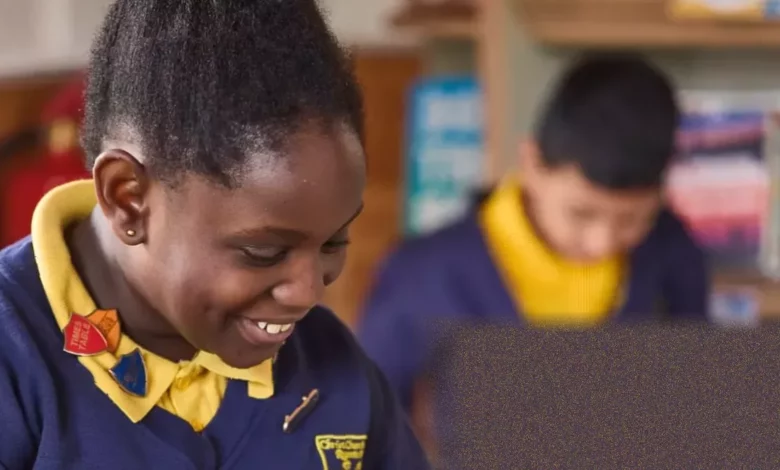
Queen Camilla, the Patron of the National Literacy Trust, has been actively launching the initiative. In February, she opened a brand new library at Christ Church Primary School in Camden, north London – the first to be unveiled in the National Year of Reading. Funded by Bloomberg, the vibrant space in the school playground is stocked with over 500 new books, comics, and audiobooks, and represents the 2,000th library opened under the wider Libraries for Primaries campaign.
For the children at Christ Church, the library is a sanctuary of excitement. “We’ve got lots of different books,” says eight-year-old Stina, one of the new librarians. Pupils like Ajmal, 7, passionately recommend the InvestiGators comic series, while Nwanneka, 9, is engrossed in the superhero school saga Kid Normal. Their enthusiasm is no accident, but the result of a sustained strategy in a school where many pupils qualify for free school meals.
Building a “Book-Rich” Culture
“Schools in areas of high disadvantage must do everything they can to be book-rich,” says Ross Fox, a teacher and English lead at Christ Church. The school’s work with the NLT has led to a tapestry of initiatives: visits from theatre groups and authors, “stay-and-read” sessions for parents, “booknics” in Regent’s Park, and protected daily story time where an adult reads to each class. Parents are even invited to sit in on phonics lessons to better support reading at home.
This approach of embedding reading into everyday culture, rather than relying on one-off events, is echoed in other schools bucking the trend. At Alton Park Junior School in Clacton-on-Sea, teacher Emma Preston dedicates the first ten minutes of weekly staff meetings to discussing books, ensuring teachers’ own knowledge and enthusiasm for modern children’s literature is sharp. For pupils, activities range from summer reading treasure hunts to “hygge” reading days where children snuggle up in dens.
The impact of such immersive experiences can be profound. Preston recalls a National Storytelling Week event where children performed for parents. “When the children were reading I turned round and every parent in the hall was smiling,” she said. A visit to a Penguin distribution centre, where pupils met author Iqbal Hussain and received signed copies of his debut novel The Night I Borrowed Time, was met with similar wonder.
The Power of “Book Gossip”
At George Green’s secondary school on the Isle of Dogs, literacy coordinator Sophie Harrison builds on the philosophy of author and educator Aidan Chambers, who believed “readers are made by readers”. The goal is to create a whole-school “community of readers” where ‘book gossip’ – the casual sharing of recommendations – flourishes in corridors and staff rooms alike.
“We’ve moved deliberately from isolated events to a sustained, everyday reading culture,” Harrison says. This is supported by staff and student book clubs, reading buddies across year groups, a dedicated school reading website, and a well-stocked library of around 8,000 titles, where damaged books are repaired in a “book hospital”.
An evaluation of the Libraries for Primaries campaign suggests such comprehensive efforts pay off. A year after implementation, 66% of children enjoyed reading more, 81% felt more confident, and 44% of those most in need showed meaningful progress in reading tests.
The Shadow of Austerity on Libraries
These school-based successes unfold against a challenging wider landscape for public library services, a traditional pillar of community literacy. Research by the union UNISON reveals the scale of the loss: almost half of England’s library staff have lost their jobs since 2010, a reduction of over 8,000 full-time roles.
Years of austerity have led to a 47% cut in staffing, a 22% reduction in opening hours, and the closure of 276 libraries without replacement since 2010. UNISON warns these cuts have left services stretched and deprived vulnerable communities, including children from low-income families, of vital support, calling for sustained government investment to rebuild.
For the National Year of Reading to succeed in its ambition of reconnecting a generation with books, the challenge is twofold. It must inspire individual passion in the face of digital distraction, as seen in the buzzing library at Christ Church Primary, while also addressing the systemic erosion of the public infrastructure designed to support that passion for all.