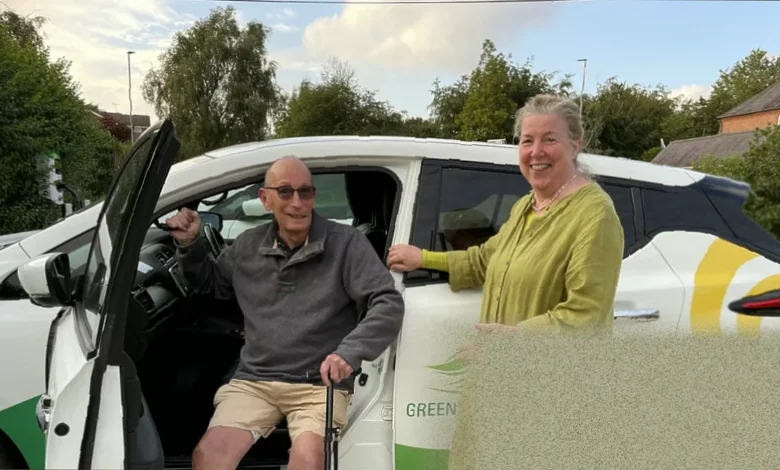
In the aftermath of the pandemic, the Leicestershire village of Tilton found a local answer to a national problem. When regenerative farmer Miriam Stoate saw neighbours struggling to get around – some with ill health who could no longer drive, others needing more than one vehicle per household – she helped launch an electric car club. Funded by the Motability Foundation and Harborough District Council, the Tilton Electric Car Club began operating in 2023. For a monthly fee, residents gain access to two electric vehicles that can be hired by the hour or by the day, and volunteer drivers are available for those who cannot drive themselves. The scheme was set up in partnership with Green Fox Community Energy, a non-profit established in 2012 that has a track record of award-winning community energy projects.
How the Tilton car club works
The club’s model is simple but carefully designed. Members pay a monthly subscription and can then book one of the two electric cars whenever they need it. For residents who have stopped driving – whether through age, illness or disability – trained volunteer drivers provide door-to-door service, so the scheme is genuinely accessible to everyone in the village. Miriam Stoate said the impact has gone beyond transport: “You can see the difference it has made to the community, not just in getting people better access to viable transport, but also helping people get to know each other more. People who would not necessarily have met previously are now friends.”
Setting up the club was not without obstacles. Stoate said the group had to secure affordable insurance – a well-known barrier for community car-sharing schemes – and overcome initial scepticism from some older residents about the safety of electric cars. “It’s been a learning curve,” she said. The support of the transport-sharing charity CoMoUK proved invaluable, and interest from other villages has since grown. “It’s about learning from each other,” Stoate added. “We now have a viable transport option that everyone can use without buying more and more cars – and it has helped to build our community, too.”
The UK’s transport emissions challenge
The Tilton initiative offers one small solution in a wider struggle. Transport is the UK’s largest source of carbon emissions, accounting for 26% of the total in 2022, and surface transport alone is responsible for roughly 28% of domestic emissions. Within that, road vehicles are the dominant contributor, making up 89% of domestic transport emissions; cars and taxis alone account for 53% (61% of surface transport emissions in 2019), with heavy goods vehicles at 17% and light vans at 16%. Progress has been stubbornly slow: domestic transport emissions have fallen by only 12% since 1990, compared with a 50% reduction in total UK domestic emissions over the same period. Meanwhile, the number of cars on UK roads is projected to increase by 10 million by 2050.
Government policy has focused on three areas: the shift to electric vehicles, improvements to public transport, and encouragement of walking and cycling. The Zero Emission Vehicle (ZEV) mandate, introduced in January 2024, requires manufacturers to sell an increasing percentage of zero-emission vehicles, with a target that all new cars and vans sold by 2035 must be zero-emission. Specifically, at least 22% of new car sales and 10% of new van sales were to be ZEVs by 2024, rising to 80% for cars and 70% for vans by 2030. There are signs that EV adoption is accelerating: sales jumped 59% in April 2026, with battery electric vehicles accounting for 26.2% of new car registrations that month (electrified vehicles – including hybrids – made up more than half). Over two million battery electric vehicles are now registered in the UK. Yet as of 2023, only 3% of cars on the road were fully electric, and the sales forecast for 2026 has been lowered to 26.8% ZEV share from an earlier 28.5%.
Anna Krajinska, UK director of the Transport and Environment group, warned that industry lobbyists are attempting to weaken the ZEV mandate by allowing more plug-in hybrid vehicles. “We have already seen some weakening of the mandate with more plug-in vehicles being allowed, which have five times the emissions of electric vehicles,” she said. “Unless we stick to the EV mandate, it will slow down the availability of affordable EVs and mean people will be locked into fossil-fuel vehicles and the volatile markets they depend on for years to come.” She called for no further slippage and for a similar decarbonisation plan for trucks and lorries.
Public transport, meanwhile, faces deep-rooted problems. Chris Hayes, chief economist at the Common Wealth thinktank, said that trains and buses in the UK have suffered from decades of underinvestment as the network was broken up and profits diverted to shareholders. “British rail passengers spend roughly three times as much per kilometre as in other countries, while half of the industry’s income comes from direct and indirect public subsidy,” he said. While the government has brought some elements of the rail system back into public ownership, Hayes argued that more is needed: “We need an integrated rail and bus service that is affordable and works for people and communities, rather than one in which the public shoulders the risk while shareholders reap the reward.”
A £3 cap on single bus fares in England (outside London) has been extended until March 2027, but the scheme is voluntary and some operators have not taken part. On active travel, the government has set an ambition that 50% of all journeys in towns and cities should be walked or cycled by 2030, backed by £616 million in capital funding for Active Travel England between 2026 and 2030. However, progress has been described as disappointingly slow, and England is currently without a cycling and walking strategy, having breached legal duties by not publishing an updated plan after the previous one expired.
Doug Parr, Greenpeace UK’s policy director, said there was “a long road ahead” before public transport becomes appealing and affordable. “Shifting journeys from cars to buses and trains won’t just reduce congestion, pollution and climate emissions, it may also help us cut our oil demand – a useful side-effect given the price and supply crunch that’s about to hit us thanks to the Iran war,” he said. But he stressed that this would require “major government investment, an overhaul of the entire train fare system and a lowering of the bus fare cap”, alongside other measures such as higher taxes on SUVs, more bike lanes and 20mph zones.
Some experts believe that even the current mix of policies is not enough. Greg Marsden, professor of transport governance at the University of Leeds, noted that the UK is on course to overshoot the government’s own carbon budget for transport by 15% if all existing targets are met. “Ambition is evaporating by the year,” he said. “Plans to reduce overall traffic have disappeared and the government is now working on the assumption that the number of cars on UK roads will increase by 10 million by 2050.” Marsden is calling for a new transport taskforce to explore more innovative approaches, including greater access to shared electric vehicles in both rural and urban areas, lighter and cheaper shared EVs for the vast majority of journeys under 30 miles, and fleets of shared EVs at major train stations to connect road and rail systems. “We spend an awful lot of money on cars … but that money could be spent in different ways and still give access to all the mobility that we need,” he said. “At the same time, it could reduce congestion and emissions, and improve the quality of people’s lives.” He emphasised the importance of working with communities rather than imposing top-down solutions – an approach that mirrors Tilton’s own experience.
A Department for Transport spokesperson acknowledged the value of car-sharing schemes, saying: “Car-sharing schemes help people travel more easily, cut congestion and reduce emissions – and we’re already encouraging councils to support them through statutory guidance. Our new transport strategy goes even further, committing to publish new guidance to help local authorities boost these services in their areas.” The DfT is also providing up to £3 million in R&D funding for innovation to tackle rural transport challenges, including AI-driven platforms for multimodal journey planning and demand-responsive transport.
Building community through shared transport
Back in Tilton, the car club has become a fixture of village life. Stoate said the scheme has not only provided a practical transport option but has also forged new social connections. “People who would not necessarily have met previously are now friends,” she said. The project has attracted attention from other villages looking to replicate the model. While challenges such as insurance and initial scepticism about electric cars had to be overcome, the support of CoMoUK was crucial. “It’s about learning from each other,” Stoate said. “We now have a viable transport option that everyone can use without buying more and more cars – and it has helped to build our community, too.”