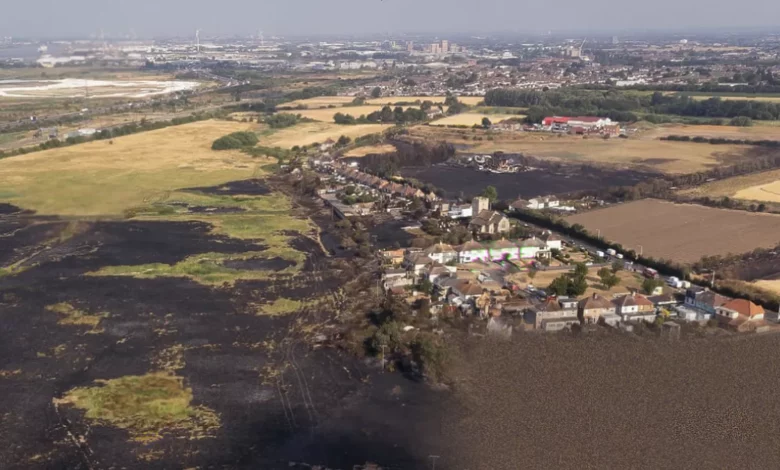
Record 600 wildfires destroyed 70 British homes in 2022 – a loss of housing on a scale previously associated with California or southern Europe, and a stark warning of how climate change is reshaping Britain’s landscape. For Lynn Sabberton and her partner, Terry, the reality of that threat arrived on the afternoon of 19 July, when neighbours urged them to flee their home in Wennington, on the eastern edge of London. Terry, struggling with a lung disease made worse by the record 40.3°C heat that day, sat in his armchair in just his underwear and refused to move, convinced the fire was too far away to matter. Two police officers kicked open the front door and shouted that it was time to go. Lynn was allowed upstairs only to grab clothes for Terry – no papers, no purse, no cat. They stumbled out into an unimaginable heat as the sky turned dark and panic swept through the crowd of neighbours. Within hours, 18 homes in Wennington were burned, including theirs.
The fire, reportedly sparked by a compost heap that spontaneously combusted around 1 p.m., crossed a two‑lane road and destroyed houses “within two minutes”, according to residents. No one was killed outright, but Terry’s illness deteriorated after months in temporary housing and he died. Lynn’s house is being rebuilt, but she will move in alone. In a cruel twist, several of the destroyed homes in Wennington were uninsured or underinsured, a problem that even prevented adjacent terraced properties from being rebuilt until solutions were found.
The Wennington blaze was just one of dozens that erupted in a great ring around London on 19 July 2022 – a day that saw the London Fire Brigade (LFB), one of the world’s largest, declare a major incident and experience its busiest day since the Second World War. The brigade deployed all 142 of its fire engines, and incident commanders made desperate appeals for more crews, hoses and water that could not be met. Across the UK, more than 800 wildfires were recorded that day; in total, 600 wildfires destroyed those 70 homes. Firefighters themselves suffered, their protective suits becoming so sodden with perspiration that one officer described it as “a boil-in-the-bag meal where you’re literally being cooked”.
The heatwave that day broke records – 40.3°C, the hottest temperature ever recorded in the UK – and the fires were made at least six times more likely by human‑induced climate change, according to research. Vapour pressure deficit, a measure of how quickly vegetation dries out, has been identified as a stronger predictor of wildfire risk in London than maximum temperature or relative humidity. Southern and eastern England could see three to four times more high‑danger fire days by the 2080s. A study by the Ordnance Survey estimated that as many as 1.8 million homes in England are close enough to green spaces to be at risk from wildfires. The prospect of a wildfire leaping uncontrolled between buildings – a process that caused devastation in Los Angeles last year – is underlined by modelling carried out by Dr Tom Smith, an associate professor in environmental geography at the London School of Economics. Using a Canadian wildfire model known as Prometheus, Dr Smith ran a dozen simulations of a wildfire that hit Dagenham on the same day in 2022, where 14 homes were lost. In the worst simulation, the fire rapidly reached 120 homes – a result Dr Smith said made “my hair stand on end”. Sami Goldbrom, an LFB group commander who has led research into future threats, warned: “Think of all the houses so close together, we’re so densely populated. There’s nothing to say that the fire couldn’t have spread all the way through and where would it stop? … It could so easily have been a second Great Fire of London.”
Systemic failures exposed
One of the most significant weaknesses exposed on 19 July 2022 was the vulnerability of water supplies – a resource essential for firefighting that is now in private hands. In Wennington, the first crew at the scene was hampered by weak pressure in the mains. When contacted by the LFB, the local water company, Essex & Suffolk Water, said the flow had been reduced “to allow them to carry out some testing”. In response to an environmental information request, the company confirmed that the flow to the village was restored only at 7 p.m., six hours after the fires had started. Although privatised water companies have a legal obligation to provide a minimum flow to households, there is no similar requirement to supply fire brigades. Northumbrian Water Group, which owns Essex & Suffolk Water, declined to comment.
Finding out which department is responsible for ensuring firefighters have enough water proved difficult. In England, fire and rescue services come under the Ministry of Housing, Communities and Local Government, while wildfire policy is the responsibility of the environment ministry, Defra. After an approach for this article, the Environment Agency responded, saying it was reviewing drought plans “to ensure water companies have worked with their local fire and rescue services to maintain adequate water supplies during fires”. The fragmentation of responsibility – spread across multiple departments and agencies – has led to what experts describe as a “fragmented”, “reactive” and “underfunded” system. Wildfire is listed on the government’s National Risk Register but is often rated as a low‑likelihood, moderate‑impact event, a classification that experts argue underestimates the true cost and threat. Meanwhile, the capacity of fire services has shrunk: around 12,000 firefighter positions have been cut since 2010.
At senior levels, the LFB had realised that higher temperatures caused by the climate crisis would make wildfires more likely, and that some would cross the “rural‑urban interface” to burn houses. But the events of 19 July showed the scale of the new threat faced by a brigade largely unfamiliar with wildfires. “We’re London, we’re urban, we don’t do fields,” a senior officer said after the fires. That has since changed: the brigade has put all crews through wildfire training, bought a fleet of all‑terrain vehicles and specialist equipment including giant sprinklers, misting lances and “Holey Hoses”, and introduced specialist roles such as wildfire officers and tactical advisors. The commissioner has publicly called for further investment to meet future wildfires. But there is still a fear of much bigger fires to come. After the fire in Dagenham, the local authority started cutting firebreaks at the edge of open spaces, and last summer one of them saved homes from a huge grass fire, the leader of the council describing the park’s staff as “unsung heroes”.
Lynn Sabberton’s house in Wennington is being rebuilt. She will be moving in alone.