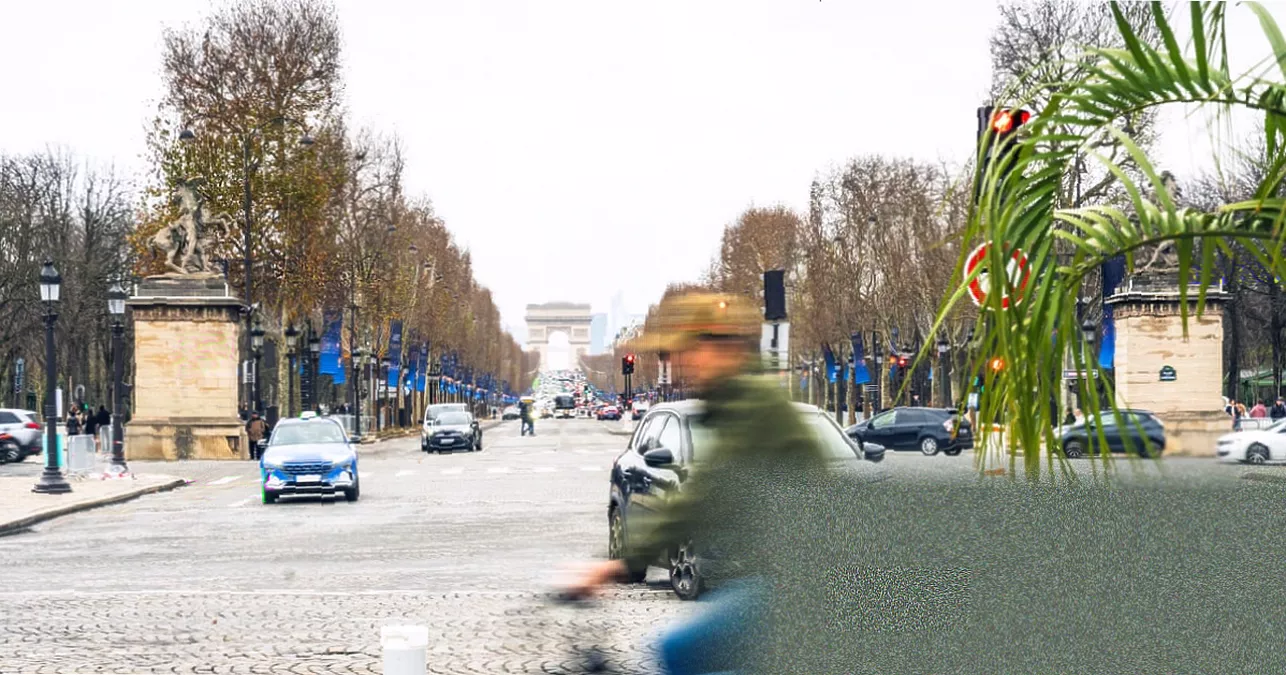
Paris has achieved a significant milestone in urban environmental health, joining just 18 other cities worldwide in dramatically reducing its levels of two toxic air pollutants between 2010 and 2024. The data shows fine particulate matter (PM2.5) fell by 55% between 2005 and 2024, while nitrogen dioxide (NO2) levels were halved, marking a transformation in the city’s atmosphere as tangible as the changes on its streets.
For Corentin Roudaut, a Paris resident for a decade, this shift is felt not in charts but in the daily rhythm of life. When he first moved from Rennes, the car-choked capital intimidated him off his bike. “Cars were everywhere. Cyclists had almost no protection,” he recalls. The turning point came when authorities installed a segregated bike lane on Boulevard Voltaire near his home. He returned to cycling, eventually volunteering with the campaign group Paris en Selle, and has watched a network of safe routes grow. “It was a process that started slow and really accelerated in the last 10 years,” he said.
That acceleration is quantified in the city’s infrastructure. Between 2005 and 2020, over 500 kilometres of bike lanes were built, two-thirds of them protected. The pace continued, with about half of the city’s 870 miles of bike lanes installed in the past decade. This expansion, part of a €250 million plan to make Paris “100% cycling-friendly” by 2026, helped the cycling modal share double from 5% in 2020 to 11% in 2025. The push saw a 70% surge in cycling since spring 2020, as temporary pandemic-era ‘coronapistes’ became permanent fixtures. The impact is generational: Paris now tops a European ranking for child-friendly cycling infrastructure, and Audrey de Nazelle, an environmental epidemiologist at Imperial College London who grew up in the city, remembers when seeing another cyclist was so rare “you could go and have coffee together.”
The Political Will to Reclaim Space
This physical transformation was driven by a concerted, and often contentious, policy drive under Mayor Anne Hidalgo, who served from April 2014 until March 2026. Her administration planted 155,000 trees, pedestrianised 300 school streets, and banned cars from the banks of the Seine—a move Hidalgo called “a tough battle.” The ambition was systemic: the “15-minute city” concept aimed to place daily necessities within a short walk or cycle, while the “Reinvent Paris” programme reallocated obsolete sites.
The most direct confrontations came from reclaiming space from the private car. Paris has banned traffic from over 100 streets and embarked on a plan to remove half of its on-street parking spaces—around 70,000—by 2030. A plan released in November 2024 proposes turning 60,000 parking spots into grounds for tree planting. In February 2024, residents voted to triple parking fees for SUVs, albeit with a turnout of just 6%. These measures have made Hidalgo a polarising figure, sparking opposition from motorists and political rivals. Rachida Dati, the right-wing mayoral candidate, criticised the resulting “chaos in public space” as “anxiety-inducing,” though she stopped short of pledging to reverse core policies.
Experts argue that implementing such change required singular political courage. “What’s missing in the rest of the world is courage,” said Audrey de Nazelle. “Mayors could say: ‘This is my opportunity [to leave a] legacy,’ but most will not dare.” The city’s unusually tight administrative boundaries, which limit suburban commuter influence, provided a structural advantage, as did groundwork by previous mayors. Yet, the will to push through policies that inconvenienced motorists for broader social and environmental gain was decisive. As Corentin Roudaut, who has advised foreign politicians, puts it: “When people ask me if I have any advice, I say don’t be afraid of being ambitious.”
Context, Catch-up, and the Unfinished Metropolis
While remarkable, Paris’s journey is also one of catching up. Giulio Mattioli, a transport researcher at the Technical University of Dortmund, notes the city started from a low base. “The conditions were there already, you just needed to make some bike lanes and people would use them,” he said. In comparative terms, Berlin still has a higher share of cyclists, London reduced nitrogen dioxide faster, and Warsaw cut PM2.5 by 46% between 2010 and 2024. Cities like Copenhagen and Amsterdam remain leading benchmarks.
The broader European context shows fragility. A political shift to the right and the rise of conspiracy theories targeting concepts like the “15-minute city” have caused setbacks elsewhere. Paris’s own progress faces a stark geographical limit: the Boulevard Périphérique. This 35km ring road acts as a concrete moat, separating the transformed inner city from the still car-dominated suburbs. Jean-Louis Missika, a former deputy mayor, authored an analysis for the thinktank Terra Nova arguing that transforming the Périphérique is essential to creating a true post-car metropolis. “As long as this 35km motorway continues to encircle Paris, the Greater Paris metropolis will remain a figment of the imagination,” he wrote.
The city’s plans for the road are ambitious: reducing its speed limit to 50 km/h, converting lanes for public transport, and envisaging a near-total pedestrianisation by 2030 to create a “green belt.” Yet this project, more than any inner-city bike lane, provokes regional conflict. Valérie Pécresse, president of the Île-de-France region, has called for a “national debate” on the remodelling, fearing displaced traffic. The ultimate test of Paris’s transformation may not be in its cleansed air or populated bike lanes, but in whether it can muster the political courage to dismantle its most formidable barrier.