Future Crossrail 2 trains running deep beneath London’s Oxford Street will be quieter than a library, generating less noise than a soft whisper or a humming refrigerator, according to detailed acoustic modelling. This prediction emerges not from active construction, but from the complex reality of building in a city where major infrastructure projects, even those in suspended animation, cast a long shadow over development today.
The Shadow of a Railway That Isn’t There
At the eastern end of Oxford Street, just north of Soho Square, plans to redevelop an office and retail block are being meticulously shaped by something that does not yet exist: the proposed Crossrail 2 railway. The project, a north-south rail link across Greater London, has been in a state of official pause since October 2020, when work on its design was halted as part of a Transport for London (TfL) funding agreement. Despite this limbo, its potential route remains protected by statutory “safeguarding directions” managed by TfL on behalf of the Secretary of State for Transport.
These safeguarding rules are a powerful planning instrument. They require local authorities to consult TfL on any development within the designated corridor, ensuring nothing is built that would preclude the railway’s future construction. While not a guarantee it will be built—with cost estimates ranging from £31.2 billion to over £40 billion—safeguarding forces developers to accommodate a ghost infrastructure. This can mean designing foundations to avoid future tunnels, or, as at the British Library, constructing entire basement structures destined to sit empty. The Library’s own expansion, starting in 2026, includes provisions for a potential Crossrail 2 station, with integrated elements that will remain unused until the wider project is revived.
The Oxford Street site is a textbook example of this forward-looking constraint. The redevelopment involves excavating a new basement and installing foundations that must avoid not only the potential path of Crossrail 2 but also the historical Post Office Railway, or ‘Mail Rail’—a driverless underground mail system that operated from 1927 to 2003 and now exists as a tourist attraction. The site is further complicated by the potential for archaeological remains from London’s English Civil War defences, constructed in 1642-3.
Navigating Vibrations in a Crowded Underground
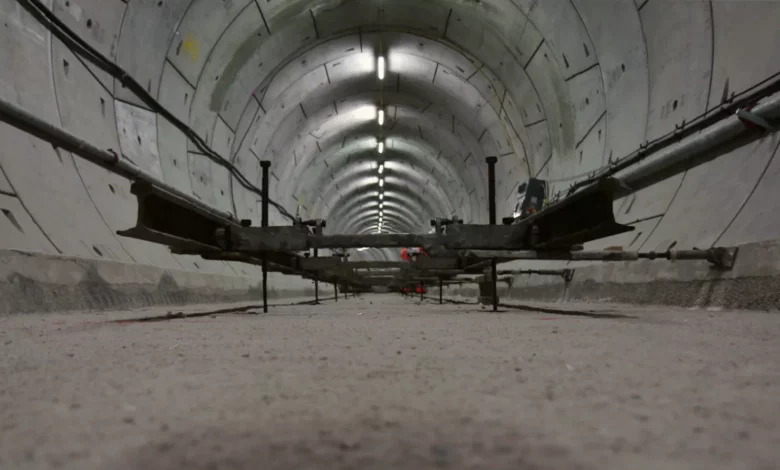
The primary technical challenge is vibration. Even with foundations designed to avoid the tunnels, their proximity means vibrations from future trains could travel through the soil and into the building’s piles, potentially shaking the offices above. Mitigating such disturbance is a well-practiced art in London; the Elizabeth Line (Crossrail 1) used specialised low-vibration track systems like Sateba’s booted sleepers and floating concrete slabs to dampen noise in sensitive areas.
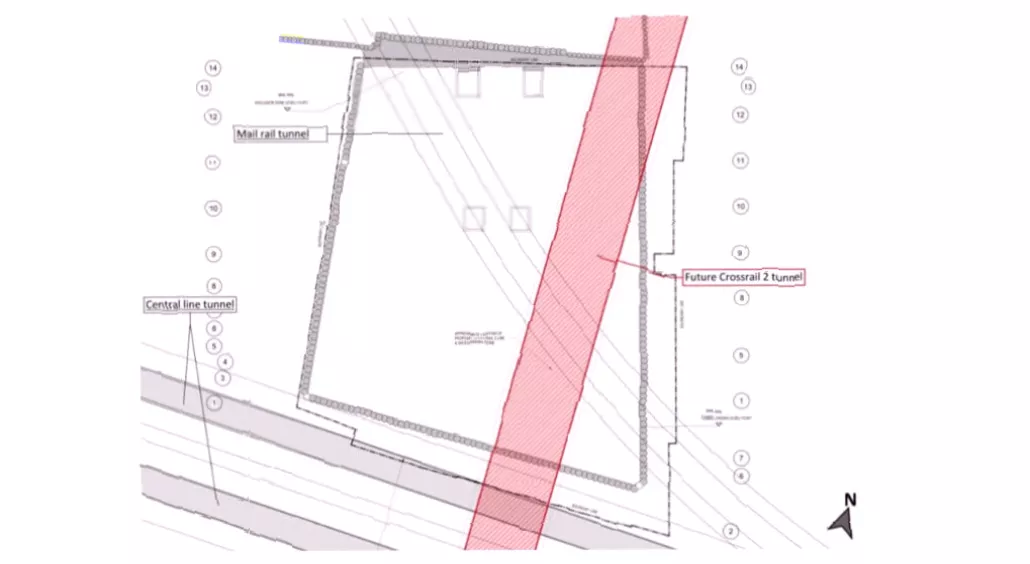
For this site, acoustic consultants Sandy Brown, commissioned by engineering firm ElliottWood, conducted detailed assessments. Their findings offer remarkable reassurance. They predict that, thanks to the spacing of the foundation piles, Crossrail 2 trains will in most cases be inaudible within the building above. In a worst-case scenario, they would only become faintly audible if trains were to reach speeds of 100km/h within the tunnel.
The predicted noise level from a fast-moving train is modelled at 36 decibels. This is not only well below the 40 dB maximum recommended for ground-borne noise in offices, but also sits comfortably within the 35-45 dB range advised for private offices and meeting rooms by the UK’s building acoustic standard, BS 8233:2014. To contextualise, 40 dB is the level of a quiet library. The occupants of these future offices, therefore, are unlikely to be disturbed by trains running approximately 70 feet below them—a testament to modern acoustic engineering and the stringent requirements baked into London’s planning process.
This meticulous planning occurs against a backdrop of significant change at street level. Oxford Street itself is undergoing a transformation, with pedestrianisation plans given the go-ahead and remaining traffic slated for removal by summer 2026. Mayor Sadiq Khan’s intention to establish a Mayoral Development Corporation for the area, with powers to override local planning authorities, adds another layer of strategic oversight. The successful regeneration spurred by the Elizabeth Line’s opening at Tottenham Court Road demonstrates the tangible benefits of such integration, even as debates continue over whether Soho should be included in the new district over concerns about noise and crime.
Ultimately, the story on Oxford Street is one of layered histories and parallel futures. It involves a defunct mail railway, civil war earthworks, a paused megaproject, and a street being redesigned for pedestrians—all converging on a single construction site. The promise of library-quiet trains is a small, precise detail in this vast urban equation, showing how London must constantly build not just for the present, but for the city it hopes one day to become.