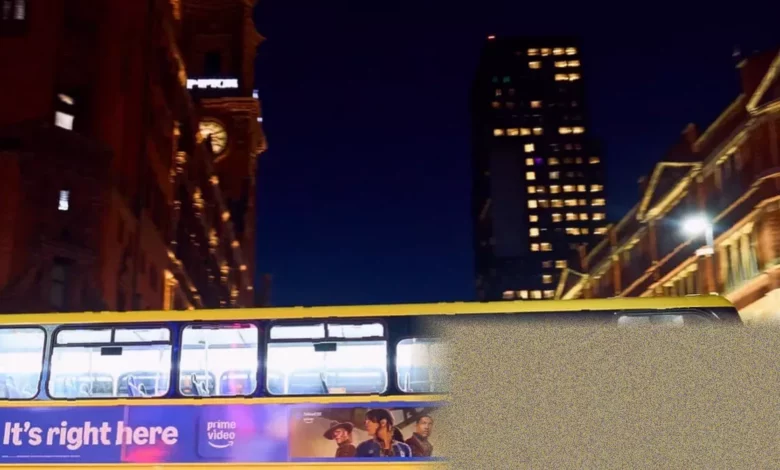
Greater Manchester is set to become the first city region outside London to offer night bus services to every local borough, marking the latest expansion of its publicly controlled Bee Network as new data reveals a dramatic surge in passenger numbers.
The move, announced by Mayor Andy Burnham, will see round-the-clock connectivity restored to all ten boroughs for the first time in decades, with services reaching previously unserved areas including Oldham, Stockport, Trafford, and Tameside. While some routes will run seven nights a week, others will operate from Thursday to Saturday, specifically targeting the night-time economy.
A “basic” service returning after decades
“The one that is quite emblematic is the return of a night bus service to all 10 boroughs. It should be a basic for a city like ours – but it’s been some time since we’ve had that,” Mr Burnham said. Transport for Greater Manchester (TfGM) estimates approximately 625,400 people work in jobs operating late into the night, underscoring the service’s importance for shift workers and the hospitality sector.
The night bus expansion is part of a wider suite of changes designed to improve connections in the region’s most deprived areas and to key employment hubs. More buses will run to business parks in Rochdale and Bolton, MediaCityUK in Salford, Manchester Airport, the Trafford Centre, and Middlebrook Retail Park in Bolton. New daytime routes, such as a service connecting Ashton, Stalybridge, and Dukinfield to Hyde, will also be introduced.
TfGM states that 740,000 people – roughly one in four of Greater Manchester’s population – will benefit from the planned changes, which are due to be implemented in the coming months and over the 2026/27 financial year.
Proof in the passenger numbers
The announcement comes alongside compelling figures demonstrating the impact of bringing buses back under public control, a process completed by January 2025 and the first such re-regulation in the UK in approximately 40 years. According to TfGM, the total distance covered by Greater Manchester buses grew 7% in the 2024-25 financial year to 82 million kilometres – more than double the growth rate of the rest of England.
Ridership has climbed sharply. Journeys on buses brought under local control in September 2023 are up 12% year-on-year, with a 14% increase on services that joined the Bee Network in March 2024. Overall, the network has seen a 14% increase in bus journeys in a year within the first franchised areas.
Performance has also improved. Punctuality in franchised areas now regularly exceeds an 80% target, a significant rise from approximately 66% before public control was reintroduced. Passenger satisfaction has surged from around 60% a few years ago to 85% today. The changes announced this week will add a further 2.5 million kilometres of bus travel per year to the network.
“You lower the fares, you improve frequency, you put routes back, people will use it – and they are,” Mayor Burnham said, referencing the £2 single fare cap and £5 day ticket which remain in place for 2026.
A political counter-argument and a model for others
Mr Burnham framed the Bee Network’s success as one of the most impactful policies of his 25-year political career and a direct counter to what he termed “a more poisonous form of politics.” He explicitly linked this to the deregulation and break-up of Greater Manchester’s buses in the mid-1980s under the government of Margaret Thatcher.
“When anyone goes on a bus here and taps on [they are] connecting with political decisions that have delivered a different transport system,” he said. The Bee Network, first unveiled in 2018, is central to the £80 billion economy’s ambition to become a “global city region,” with a long-term goal for 90% of residents to live within 400 metres of a 30-minute bus or tram service by 2030.
The model is now being looked to by other regions. South Yorkshire’s Mayor, Oliver Coppard, this week announced a blueprint for a ‘People’s Network’, aiming to integrate buses and trams after they are taken back into public control next year.
Regional leaders’ ambitions have been bolstered by Chancellor Rachel Reeves’s plans to devolve control of a share of national taxes. Mr Burnham described this as a “permanent transfer of power and resources” and “possibly the most significant moment” since devolution plans were first announced.
The journey towards full integration
The Bee Network is envisioned as a fully London-style integrated transport system. While currently encompassing buses, trams, cycling, and walking, its next major phase is the integration of commuter rail. The first rail lines, Manchester to Glossop and Stalybridge, are scheduled to join the network by December 2026, with full integration targeted for 2028, leading to capped fares across all modes.
Concurrent plans for expanding the Metrolink tram network continue, with a target for 90% of people to be within a five-minute walk of a frequent service by 2030. For Mayor Burnham, the expanding Bee Network represents a tangible reversal of decades of fragmentation. “We put the bee on the side of the buses to denote that public control. And now we’re acting visibly, tangibly in the interests of our residents,” he said.