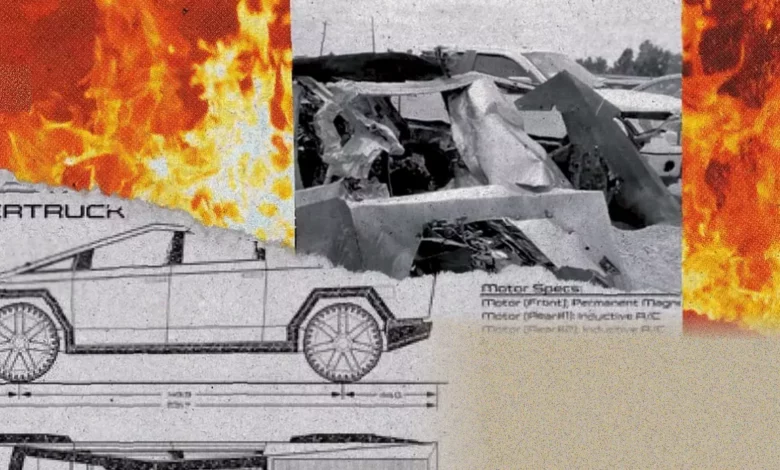
When first responders reached a quiet Texas road in the early hours of an August morning last year, they were confronted by an inferno. Through heavy smoke, sheriff’s deputies could make out the blazing hulk of a Tesla Cybertruck, flames leaping more than ten feet high. Their attempts to approach were beaten back by the intensity of the heat. It was only after firefighters spent considerable time dousing the wreck—and its repeatedly reigniting batteries—that they made a grim discovery inside: the severely burnt, unidentifiable remains of the driver.
A Pattern of Fiery Crashes and Trapped Occupants
That driver was 47-year-old nurse practitioner Michael Patrick Sheehan, who had owned the vehicle for just three months. His death in Baytown is one of five known Cybertruck fires tracked since the model’s debut two years ago, a small but alarming number given only around 60,000 units have been sold. These incidents have resulted in four fatalities and are the subject of multiple lawsuits alleging a critical design flaw: in a crash, passengers can become trapped inside a rapidly burning vehicle.
Sheehan’s family contends in their wrongful death suit that the crash forces were survivable, but he was unable to escape the ensuing blaze, which they claim reached temperatures hotter than a cremation oven. The lawsuit alleges the Cybertruck’s design led directly to this worst-case scenario. Lawyers for the family are currently seeking camera, sensor, and vehicle data from Tesla to understand the final moments of the crash, a request the company is resisting.
The tragedy in Texas bears stark similarities to a crash months later in Piedmont, California. In November 2024, a Cybertruck carrying four friends crashed into a tree at high speed and immediately caught fire. A witness, Matthew Riordan, ran to the scene and tried desperately to open the doors and smash the windows with a tree branch. According to lawsuit complaints, he managed to pull one friend from the front seat but could not rescue three others from the back as the fire became an “inferno.” Autopsy reports for Soren Dixon, Krysta Tsukahara, and Jack Nelson concluded they died from smoke inhalation and severe thermal injuries, not from the impact itself. The sole survivor, Jordan Miller, suffered life-altering injuries.
These incidents highlight what safety experts describe as a deadly convergence of factors unique to the Cybertruck. The vehicle’s exterior door handles are flush, electronic, and absent on early models. If power is cut in a crash, they may not function. Occupants must then find an internal manual release—a lever by the window switches in front, or a hidden cable inside the rear door pocket, beneath a rubber mat. Tesla’s own emergency response guide offers no external method to open the doors, stating simply: “Extrication may be required.”
Compounding the problem are the vehicle’s high-density laminated windows, which are harder to break than standard car glass. Michael Brooks, executive director of the Center for Auto Safety, argues that while other manufacturers use intuitive motions to open doors in an emergency, Tesla’s system requires locating a specific manual release. “Those are motions of a person who is trying to escape,” Brooks said. “In Teslas, that doesn’t work.”
The “Thermal Runaway” Threat and a Firefighter’s Nightmare
Once a fire starts, a Cybertruck blaze presents a distinct and severe challenge. The fires stem from the lithium-ion battery pack, where a phenomenon called “thermal runaway” can occur. If physical damage causes cells to overheat, they can combust in an uncontrollable chain reaction, igniting neighbouring cells. These battery fires burn much hotter and longer than gasoline fires and are notoriously difficult to extinguish.
Tesla’s emergency guidance acknowledges this, warning that “large amounts of water”—between 3,000 and 8,000 gallons for a single battery—must be applied directly to the battery pack, and that “there is always a risk of battery re-ignition.” This was evidenced in a Harlingen, Texas incident where a Cybertruck burned for 90 minutes after hitting a fire hydrant, and again in Los Angeles, where a crashed Cybertruck reignited in a tow yard after being doused at the scene.
That Los Angeles incident involved Alijah Arenas, a University of Southern California basketball recruit. In April 2025, he lost control of his Cybertruck after the steering wheel became unresponsive, crashing into a fire hydrant and a tree. He recounted being trapped inside the burning vehicle, unable to open the doors due to thick smoke, before passersby peeled back a window to rescue him. He spent six days in hospital recovering from smoke inhalation.
High Ratings, Multiple Recalls, and Falling Sales
Despite these serious incidents, the Cybertruck has scored top marks in formal safety testing. The National Highway Traffic Safety Administration (NHTSA) awarded it a five-star overall safety rating for the past two years, and the Insurance Institute for Highway Safety gave later models its “Top Safety Pick+” award. However, safety experts note a critical gap: NHTSA has not yet developed standards for “egress”—the ability to exit a vehicle after a crash—meaning this factor is not evaluated in the tests.
Concurrently, the vehicle has been subject to a series of recalls. Most notably, Tesla recalled over 46,000 Cybertrucks—nearly all those on the road at the time—due to a risk of exterior trim panels detaching because of a faulty adhesive. Other recalls addressed issues with accelerator pedals, rearview camera delays, and overly bright parking lights.
https://x.com/elonmusk/status/1996484482514428311
The vehicle’s commercial momentum appears to have stalled. After selling approximately 39,000 units in 2024, sales halved in 2025 to just over 20,000, the steepest drop of any electric vehicle in the US market that year. Some industry analysts have labelled its performance a commercial disappointment. The Cybertruck is also not permitted for sale in Europe due to design regulations, with concerns cited about pedestrian safety related to its angular design and rigid structure.
Tesla’s Response: Denials, Defence, and Potential Changes
In court filings responding to the lawsuits, Tesla has consistently denied any wrongdoing. The company states the Cybertruck is compliant with all federal safety standards and that it has fulfilled its duty to warn customers of risks. It has blamed driver negligence in specific crashes, arguing in the Piedmont case that the occupants “knowingly and voluntarily” assumed risk, and in the Sheehan case that his own actions contributed to his death.
CEO Elon Musk has remained a vocal champion of the vehicle, calling it an “incredible vehicle,” Tesla’s “best ever,” and “apocalypse-proof.” He has emphasised a design philosophy of toughness, telling podcaster Joe Rogan that “trucks should be manly… And bulletproof is maximum macho.”
Internally, there are signs the company is reviewing the door mechanism. Chief designer Franz von Holzhausen said in a September podcast that Tesla was investigating combining the electronic and manual releases into one intuitive button. Furthermore, in December, Tesla updated its safety webpage to state that doors will automatically unlock during a serious collision. Safety experts caution, however, that without power, the lack of a physical latch may still render the handles inoperable.
The NHTSA has opened investigations into similar electric door handles on Tesla’s Model 3 and Model Y sedans, following over 140 consumer complaints tracked by Bloomberg about doors locking occupants in. Regulators in Europe and China are moving to tighten rules on flush handles. At least 15 people have died over the past decade after being trapped in burning Teslas, according to Bloomberg’s analysis, with at least four of those fatalities occurring in Cybertrucks.
For the families of Michael Sheehan, Krysta Tsukahara, Jack Nelson, and others, the legal battles continue. They are united in a central allegation: that a vehicle sold as the pinnacle of strength and innovation contained a fatal flaw, turning a survivable crash into a death trap. As one lawyer for the victims put it, the responsibility for the crash may lie with the driver, but the inability to escape afterwards rests with Tesla.