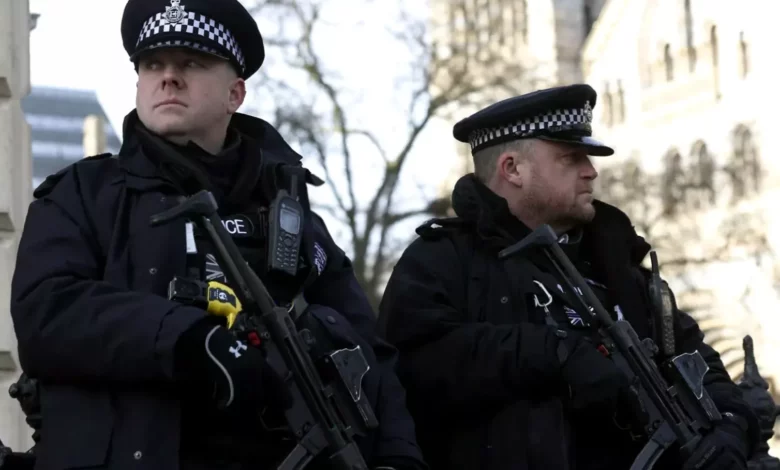
Security services and police in London are conducting a major counter-terrorism operation amid urgent warnings from US intelligence that Iran may be activating sleeper cells in the West, following the assassination of its supreme leader last month.
The Metropolitan Police have been granted additional time to question four men arrested in a series of raids last week. The force confirmed the men, one Iranian national and three dual British-Iranian nationals aged between 22 and 55, were detained under the National Security Act at addresses in Harrow, Watford and Barnet. They are suspected of conducting espionage for the Tehran regime, specifically targeting locations and individuals linked to the UK’s Jewish community.
In a related development, six other men arrested at the Harrow address on suspicion of assisting an offender have been bailed. One of those men was also arrested on suspicion of assaulting a police officer.
Intercepted Signals and a Heightened Alert
These arrests in London coincide with a federal alert issued to US law enforcement agencies, as first reported by ABC News. According to the alert, American officials intercepted encrypted communications, believed to be of Iranian origin, which may serve as an “operational trigger” for sleeper assets abroad.
The signal was reportedly relayed across multiple countries shortly after Ayatollah Ali Khamenei was killed in a joint US-Israel strike on February 28, 2026. The transmission was encoded for “clandestine recipients” possessing the correct key, a method that bypasses conventional internet and mobile networks. While the contents remain undeciphered, a US government memo stated the “sudden appearance of a new station with international rebroadcast characteristics warrants heightened situational awareness.”
In response, FBI counterterrorism and intelligence agents are reportedly working “24/7” to disrupt potential threats. Former US Department of Homeland Security senior adviser Charles Marino has warned of a “convergence” of dangers, ranging from Iran-aligned lone wolves to organised sleeper cells.
A Long-Standing and Evolving Threat
Experts stress that the current crisis has amplified a pre-existing Iranian threat to the UK. Dr Andreas Krieg, an associate professor in security studies at King’s College London, told The Standard that UK intelligence is on high alert. “Periods of heightened confrontation create incentives for Tehran to demonstrate reach,” he said. “A leadership shake-up can trigger riskier signalling if decision-makers feel threatened.”
He explained that Iranian networks traditionally used to harass dissidents could be “repurposed for retaliation,” providing surveillance or facilitating contacts with criminal intermediaries. Dr Krieg also noted that Iran’s Revolutionary Guard Corps (IRGC) often utilises individuals abroad with “Basij ties, sympathies, or past service” for low-visibility tasks, who can be activated when needed.
The concept of a “sleeper cell” involves agents who live outwardly normal lives until activated, providing a clandestine link between overseas planners and operatives on the ground. The threat is considered both credible and complex, with Iran believed to maintain small clandestine cells inside and outside the US.
The UK has repeatedly been a target. MI5 Director-General Ken McCallum revealed that by October 2025, security services had thwarted over 20 “potentially lethal” Iranian-backed plots in the preceding year. Recent incidents include the 2023 conviction of an Austrian man for hostile reconnaissance against the Iran International TV channel’s London headquarters, and the stabbing of one of its journalists in 2024.
Just last year, in May 2025, British counter-terrorism police arrested eight suspects in two operations. Five were held over a suspected terror plot, potentially against the Jewish community, while three others were detained on espionage charges. A September 2025 report indicated the IRGC was using online grooming to recruit operatives in Britain for roles including spying and intimidation, with MI5 allegedly uncovering at least one bomb plot with a potential scale comparable to the 7/7 London attacks.
The pattern extends internationally. Last week, Qatar announced the arrest of 10 suspects from two IRGC cells; seven were assigned to spy on vital facilities, while three had received drone training for sabotage operations.
Security Response and Worst-Case Scenarios
In response to the heightened threat level in London, it was reported on Sunday that an SAS team has been moved to the capital. The Ministry of Defence has neither confirmed nor denied this deployment.
Security analysts warn the nature of any attack could vary significantly. Retaliation could involve state-backed terrorism or cyber operations against critical British infrastructure like banks and energy supplies. The threat also encompasses the risk of so-called “lone wolf” attackers, individuals inspired but not directly controlled by Tehran.
The i Paper reported there could be “thousands of individuals” who might see an “opportunity and a cause to attack now”. An intelligence source warned that, in a worst-case scenario, the UK could potentially witness another year like 2017—which saw five terrorist incidents claim 40 lives and injure more than 900 people, most devastatingly in the Manchester Arena bombing.
Dr Krieg cautions that while harassment and surveillance are common, moving to a physical attack represents a major escalation with higher operational risk for Iran.
Economic Shockwaves from the Conflict
The geopolitical crisis is already impacting the UK economy. Oil prices have soared above $100 a barrel for the first time since 2022 due to the conflict. Chancellor Rachel Reeves has stated the Middle East crisis is “likely to put upward pressure on inflation” in the coming months, a concern echoed by Prime Minister Sir Keir Starmer, who warned of potential economic damage the longer the war continues.
Ms Reeves said she was prepared to support a coordinated international release of oil reserves to ease the shock and called for action to guarantee security in the vital Strait of Hormuz. However, a meeting of G7 finance ministers on Monday concluded without agreement on any firm action.
Back in London, detectives from Counter Terrorism Policing have until March 13 to question the four men arrested on suspicion of spying, as security services work to determine whether the intercepted signals and the alleged surveillance network are connected pieces of a broader Iranian activation order.