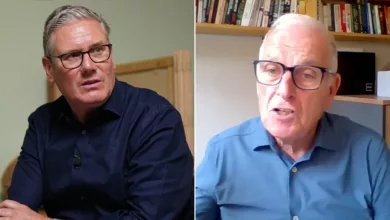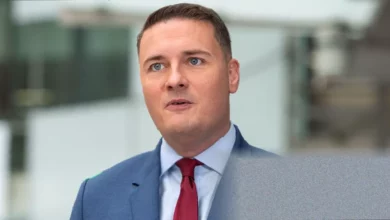
Peter Mandelson was denied security vetting for the post of ambassador to the United States because of concerns about his ties to senior figures in China, Russia and the late financier Jeffrey Epstein, multiple sources have told the Guardian. The Liberal Democrat leader, Ed Davey, said it was “an utter disgrace” that the government was still trying to keep the details secret, and accused Downing Street of wilfully ignoring “glaring warning signs” driven by a “desperate desire to pander to the bully in the White House rather than protect British interests”.
According to sources familiar with the process, the UK Security Vetting (UKSV) agency compiled a nine-page summary of Mandelson’s file in January 2025 that listed several specific concerns. These included his links to China’s finance minister, Lan Fo’an; the sanctioned Russian oligarch Oleg Deripaska; and a former Israeli military intelligence general, Tamir Hayman. A fourth individual, who is British, was also flagged as having a relationship with Mandelson that could be compromising. The vetting agency further noted a £1 million loan Mandelson received to invest in an Israeli startup, and recorded that he appeared “naive” about the risk that historical relationships with other individuals could be exploited. Number 10, Davey insisted, knew “full well about Mandelson’s business relationships with China and Russia, and indeed with Jeffrey Epstein too”.
Blair’s essay sparks fierce backlash from all sides
Tony Blair’s essay “Labour and the future”, published this week, has drawn broad criticism from across the political spectrum, with the former prime minister accused of offering a “flawed analysis” that fails to understand how much Britain has changed since he left office. Larry Elliott, the Guardian’s former economics editor, described the intervention as “one part nostalgia for a golden Blairite era that never was, one part belief that AI is the answer and one part failure to accept that the current crop of Labour politicians might be on to something”. He concluded that Blair’s advice – to occupy the centre ground, snuggle up to big business, cut welfare and embrace AI – was “fantasy-island stuff”.
Invoking Trump, Meloni and Milei as proof that voters want cults while insisting he is a sensible technocratic realist. This is Blairism with an AI wrapper: pro US, markets, deregulation, welfare cuts, techuptopia and impatience with democratic drag. Nah https://t.co/mmJYyFBSNQ
— Randeep Ramesh (@tianran) May 27, 2026
Andy Burnham, the mayor of Greater Manchester, who was singled out for criticism by Blair for arguing that politics has failed people for the past 40 years, gave a robust riposte. He said Blair “doesn’t mention inequality once” and argued that the policies of the past four decades had delivered “wide inequality” that was “responsible for the abandonment of the centre”. Burnham also rejected Blair’s claim that the private sector is always more effective than the state, noting that “when it comes to essential services the evidence is pretty clear it isn’t the fix”. He pointed to two specific failures of Blair’s own premiership: an overemphasis on sending children to university, which he said “is a significant part of the problem that has left out too many people”, and the failure to find a solution to social care despite Blair’s 1997 conference pledge to end the sale of homes to pay for it.
The essay drew sharp responses from Labour figures on the left. Richard Burgon, secretary of the Socialist Campaign Group, said Blair’s “neoliberalism, backing of endless wars and acceptance of inequality are exactly what Labour must break from”. Diane Abbott characterised Blair’s policy framework as “support every US war, cut welfare and pensions, deregulate and privatise, continue anti-migrant policies”. Jeremy Corbyn, the former Labour leader, said the answer was not AI and welfare cuts but “a redistribution of wealth and power and the relentless search for peace”. Zarah Sultana called Blair a “war criminal with the blood of over a million Iraqis on his hands”. Yanis Varoufakis, the former Greek finance minister, denounced Blair as “the living embodiment of what happens when political office becomes a down payment on future plunder”.
Blair writes apparently ignorant of the work of Nobel prize winners Philippe Aghion and Angus Deaton. The tech revolution must be accompanied by a social contract revolution and the addressing of multiple inequalities. Otherwise it dies. Labour has to respect these realities.
— Will Hutton (@williamnhutton) May 27, 2026
Even more moderate voices were sceptical. Torsten Bell, the Treasury and pensions minister and former head of the Resolution Foundation, acknowledged Blair’s skill at laying out a political argument but said the essay “puts politics not serious policy first”. He challenged Blair’s claim that taxes had risen because of welfare, pointing instead to higher debt interest costs and the unwinding of austerity, and argued that raising VAT in a period of high inflation would have been “a recipe for much higher interest rates”. Stewart Wood, a Labour peer and former adviser to Gordon Brown, warned that Blair’s “big bet on the ultimate benevolence of corporate giants” ignored rising voter anger about unchecked corporate power. Caroline Lucas, the former Green MP, said Blair’s dismissal of net zero and his claim that fossil fuels are cheaper than renewables was “extraordinary” given the climate crisis.
Blair also argued that the pensions triple lock is unsustainable. Dan Tomlinson, the Treasury minister, defended the policy, saying it was “the right policy” and in the party’s manifesto. Political commentator Sam Freedman noted the tension between praising “grown-up” decisions in the abstract and criticising anyone who tries to implement them.
Resident doctors in England to strike in June
The British Medical Association has announced that resident doctors in England will strike from June 15 to 19, with further action possible in July, as part of their long-running dispute over pay. The union criticised the new health secretary, James Murray, for failing to improve the government’s offer. Jack Fletcher, chair of the resident doctors committee, said they had “hoped that a change in leadership at the Department of Health and Social Care would lead to a change in approach” but had instead encountered “the same unwillingness to move we encountered under Mr Streeting”. He added: “We cannot be asked to negotiate in good faith for weeks, only to be told there is nothing left to negotiate about on pay.”
TB essay is refreshingly well-written, and spot on both in diagnosing the problem and analysing the appeal of the unconventional politician, but I think the proposals are less useful – either wrong (eg we should fully support whatever mad adventure Trump has decided to go on) or,…
— Sienna Rodgers (@siennamarla) May 27, 2026
In a separate development, the Home Office has rejected a proposal to allocate government funds for reviews into domestic abuse-related deaths, according to Geraldine McKelvie’s reporting.
Keir Starmer and his Polish counterpart, Donald Tusk, signed a Polish-British defence and security treaty at the Battle of Britain Bunker in west London on Friday. Starmer called it a “generational uplift” in the UK’s relationship with Poland, specifically referencing the threat from Russia. The treaty covers mutual support, joint exercises, military procurement, air defence, cybersecurity and infrastructure security, including the joint use of “uncrewed systems” and accelerated cooperation on tackling disinformation. Tusk said the agreement was rooted in “our shared values” and a determination to “defend both countries and its peoples”.