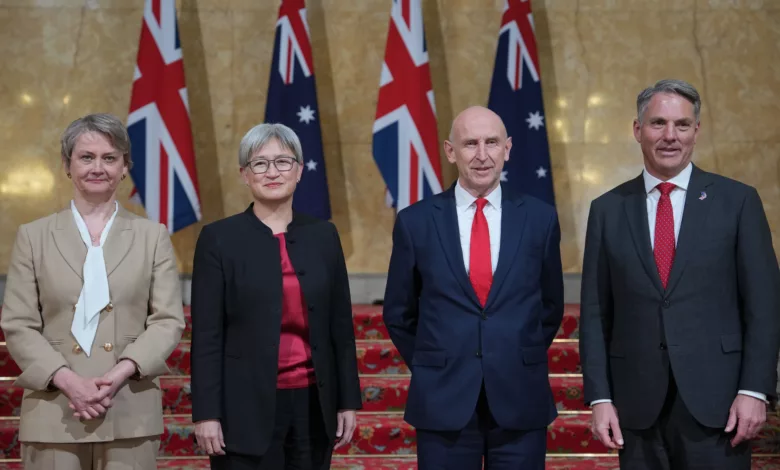
Defence Secretary John Healey has insisted that Sir Keir Starmer is fully aware of what the nation requires for its defence, as the long-delayed Defence Investment Plan continues to fuel a political row over both timing and funding.
Speaking alongside Foreign Secretary Yvette Cooper and their Australian counterparts at the annual AUKMIN summit at Lancaster House, Mr Healey stressed: “When we publish really significant reports from defence, we respect Parliament.” His comment came as the government faced mounting pressure over when – and how – the plan would finally be released, with the Speaker of the House of Commons warning that any Friday announcement would amount to a deliberate bypass of parliamentary scrutiny.
Parliamentary Anger Over Publication Timing
Sir Lindsay Hoyle, the Speaker, publicly denounced rumours that the Defence Investment Plan might be published this coming Friday, a day the House of Commons does not sit. He said such a move would be “an utter disgrace and an utter kick in the face to members of this House,” reflecting deep unease that MPs would be denied a chance to question the government on its defence commitments.
Mr Healey’s insistence on respecting Parliament suggested that Monday is the earliest possible date for publication, though the Prime Minister may still make some remarks about his defence plans this week. The row escalated at Prime Minister’s Questions, where Conservative leader Kemi Badenoch berated Sir Keir Starmer over the repeated delays, accusing the government of dithering while the security situation deteriorates.
A Funding Gap Under Scrutiny
The core of the dispute lies in a stark discrepancy between what defence chiefs say is necessary and what the Treasury appears willing to offer. According to reports, the government is considering an extra £13.5 billion for defence over the next four years – less than half the £28 billion that senior military figures say is required merely to sustain existing commitments and implement the changes demanded by last year’s Strategic Defence Review.
Such a funding level would fall short of the ambitions Sir Keir himself set out at the Munich Security Conference in February, where he called on allies to “go further and faster” on defence. Yet the reality, critics argue, has been foot-dragging, dither and delay. The Defence Investment Plan, designed to translate the Strategic Defence Review into concrete spending commitments, has still not been published months after it was expected.
Britain’s current defence spending stands at 2.4 per cent of GDP – or, according to official figures for 2024–25, £66 billion equating to 2.3 per cent of national income. The government has pledged to increase that to 2.5 per cent by 2027–28 (or 2.6 per cent including security service spending). But Labour’s longer-term commitment – to reach 3 per cent of GDP in the next parliament – could come as late as 2034, a timeline critics say is far too slow given the scale of the threat.
At last summer’s NATO summit in The Hague, Britain joined other allies in pledging to invest 5 per cent of GDP on defence and defence-related spending by 2035. That target, pushed by US President Donald Trump within weeks of his return to office in early 2024, breaks down as at least 3.5 per cent for core defence and 1.5 per cent for adjacent spending. Mr Healey repeated on Wednesday that “the UK has always met its Nato commitments and it will continue to do so,” but the 5 per cent promise remains nearly a decade away, well beyond the next general election. Labour may not even be in power when that deadline arrives.
The contrast with other European nations is striking. Germany, long a reluctant spender on defence, has undergone a dramatic transformation since Russia’s full-scale invasion of Ukraine. It announced a €100 billion special fund in 2022 and intends to increase its defence budget from €86 billion in 2025 to €152 billion by 2029, aligning with the 5 per cent target. By that point, Germany’s military expenditure is projected to exceed that of the UK and France combined. Germany reached NATO’s 2 per cent threshold for the first time in 2024 and is now rearming at pace.
Poland has gone further still. Its defence spending reached 4.3 per cent of GDP in 2025, rising to an estimated 4.8 per cent in 2026 – a $55 billion budget that makes it the alliance’s biggest spender as a share of national income. Warsaw has donated much of its Soviet-era equipment to Ukraine and is rapidly acquiring modern NATO-compatible platforms. Across Europe, allies and Canada collectively increased defence spending by 20 per cent in real terms between 2023 and 2024, while European Union defence budgets rose 60 per cent between 2020 and 2025.
The UK, once home to NATO’s second-largest defence budget, was overtaken by Germany in 2024. In that year, Britain spent 2.3 per cent of GDP on defence, compared with 2.0 per cent for both Germany and France. Though it still meets the alliance’s 2 per cent guideline – a target it has hit every year since 2006 – many other European nations are now increasing their spending at a faster rate.
The reasons for the delay are, as Mr Healey acknowledged, the dangerous state of the world and the lack of money. “The world is more dangerous and more uncertain,” he said. Polish Prime Minister Donald Tusk told the European Political Community in Copenhagen last October: “It’s war!” The list of threats cited by the government includes Russian disinformation, interference with undersea cables, drone incursions, the continuing war in Ukraine, the conflict in the Middle East, the economic disruption caused by the closure of the Strait of Hormuz, an increasingly assertive China in the Indo-Pacific, and an unpredictable United States under a president who, months ago, insisted Washington “has to have” Greenland, a territory belonging to NATO ally Denmark.
Yet despite the rhetoric, the Treasury has dug in its heels. The Defence Investment Plan’s credibility depends on adequate funding, but the historical record shows that while capital spending on equipment rose by 95.5 per cent in real terms between 2015–16 and 2023–24, day-to-day spending fell by 2.4 per cent. The Ministry of Defence already holds the largest capital budget of any government department, but maintaining that pace requires hard choices. Tax rises or spending cuts – possibly both – are on the horizon.
The world is more dangerous. But the government has yet to level with the public about the painful choices which will have to be made if it is to keep us safe.