Liz Truss: right-wing factions must coalesce to present viable alternative to fringe policies

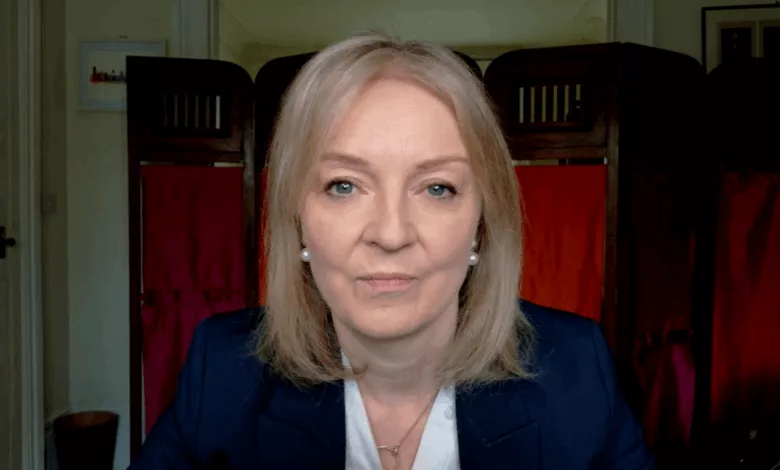
Liz Truss has declared that Britain’s political system is so “badly broken” that voters are turning to “crazy alternatives”, a warning she issued as she urged the right to unite behind an agenda to reverse the legacy of Tony Blair and restore what she called “a proper parliamentary democracy”.
The former prime minister, whose 49-day tenure in 2022 remains the shortest in British history, argued that the UK has become “ungovernable” not because of the individuals occupying Number 10 but because of a deeper “system problem”. She pointed to the succession of seven prime ministers within a decade as evidence that the machinery of government itself is jammed.
“People have got to understand there’s a bigger problem than the identity of the person in Number 10 Downing Street,” Truss said. “We’ve got a system problem, and it’s all of our responsibility to try and fix that.”
Central to her critique is the failure of successive Conservative governments over the past 14 years to reverse what she described as key Blair-era policies that rendered the country ungovernable. She singled out two pieces of legislation in particular: the Human Rights Act and the Climate Change Act.
The Human Rights Act and the Climate Change Act: ‘Key policies that made our country ungovernable’
Truss has long been a vocal opponent of the Human Rights Act, which she wants repealed and replaced with a dedicated British Bill of Rights. She has said she is willing to go further and withdraw the UK from the European Convention on Human Rights if attempts to curb the influence of judges in Strasbourg do not succeed. In her view, the Act has given the judiciary and international courts powers that override the decisions of elected British ministers, particularly in areas such as asylum policy. “Currently, Government ministers have very little say over key things that happen in our country,” she said, citing the asylum system as an example where the executive’s hands are tied.
The Climate Change Act, meanwhile, is another Blair-era law Truss believes must be scrapped. While she has publicly committed to the UK’s net-zero target by 2050, her critics point to contradictions in her record: during her premiership she pushed policies that encouraged fossil fuel extraction and made it harder to expand renewable energy, and she proposed suspending the “green levy” on household energy bills. For Truss, the Act symbolises a broader pattern of legislative straitjacketing that prevents ministers from responding to immediate economic pressures.
She also identified the Equality Act as a piece of legislation she would like to see repealed, further illustrating her view that a thicket of Blair-era laws has transferred power away from Parliament and into the hands of unelected bodies.
The ‘blob’ and the deep state
Beyond specific statutes, Truss blames what she calls “the blob” — a network of unelected bureaucrats, the judiciary, and institutions such as the Bank of England — for obstructing elected politicians. She has claimed these institutions have been “taken over by the left” and that they actively thwart the implementation of a conservative agenda. Her own experience in office, she argues, is proof: the “catastrophic reaction” to her September 2022 mini-budget, which announced large tax cuts and borrowing and triggered market turmoil, was not merely an economic error but a symptom of a system that punishes any attempt to challenge the established orthodoxy.
Truss has frequently claimed that an entrenched “deep state” worked against her government. Her economic package — branded “Trussonomics” and built on deregulation and tax reduction — was intended to turbocharge growth, but the resulting financial instability forced a rapid U-turn and ultimately her resignation. She insists the episode vindicates her diagnosis that the UK’s governance structures are fundamentally broken.
The need for reversal and a right-wing revival
Truss is now calling for a concerted effort to reverse what she terms “Blairism”. “We need to have an agreement on the right to reverse the Human Rights Act and get rid of the Climate Change Act and really take back control of our country,” she said. “The public are increasingly realising that the country’s become ungovernable.”
She argues that the right must present a coherent policy platform to counter the “crazy alternatives” gaining traction — a reference she has elsewhere linked to Donald Trump’s political movement, explicitly calling for Britain to have its own “MAGA moment”. She has criticised parts of the Conservative Party for lacking ideological clarity, comparing some Conservative politicians to “RINOs” (Republicans in Name Only), and accused the Labour Party of being influenced by “pro-terrorist” activists.
The former prime minister, who began her political career as president of the Oxford University Liberal Democrats and once advocated abolishing the monarchy, now positions herself as a standard-bearer for a revival of classical liberalism within the Conservative fold. Her memoir, Ten Years to Save the West, lays out her case that the establishment — including civil servants, bankers, and the judiciary — conspired to bring her down.
In Truss’s analysis, the answer is not a change of personnel but a structural reset. “The right needs to get behind an agenda, which is about reversing Blairism and returning our country to a proper parliamentary democracy,” she said. “The errors of the Conservative Governments over the 14 years was not really reversing some of the key Blair policies that made our country ungovernable.”