M4 gridlock becomes decisive election battleground in Wales
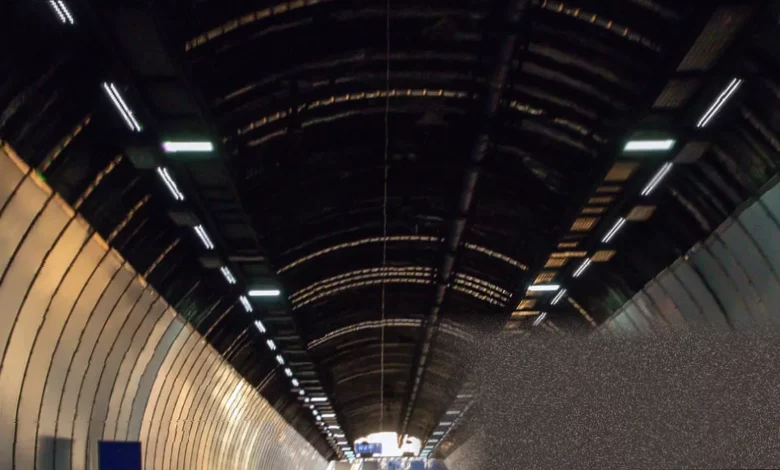
It is afternoon rush hour on the M4 and drivers are once again crawling towards the Brynglas tunnels, where the road narrows to two lanes in each direction and flashing lights warn motorists in Welsh and English of a ciw — a queue. The congestion around Newport, the gateway between Cardiff and Bristol, has become an everyday frustration for commuters and hauliers, but it has also emerged as a major flashpoint in the campaign for the Senedd elections on 7 May — a vote widely expected to end Labour’s grip on power for the first time since devolution in 1999.
Cars and lorries are frequently stuck in gridlock on both approaches to the tunnels, and if an accident occurs, “the whole of Newport is gridlocked,” said Rosemary, 81, a retired shop worker waiting at the city’s bus station. “We could have done with that new relief road, it would have been a big help.” She added that the bus service has become “really poor since the pandemic”, leaving her dependent on an unreliable network to visit her daughter and go shopping.
Poor public services — especially long NHS waiting times — rank top of voters’ concerns, alongside transport. But the M4 tailbacks have prompted fiery exchanges between party leaders, with the six main parties split over how to tackle them.
Political divide over a new road
Two of the candidates to become first minister — Plaid Cymru’s Rhun ap Iorwerth and Reform UK Wales’s Dan Thomas — both support a new relief road, as do the Conservatives. Labour, the Greens and the Liberal Democrats are opposed. The issue has fuelled debate about the future of the M4 corridor, a route that has seen proposals for a relief road stretch back more than three decades.
The Welsh Office first mooted a relief road in 1991, but it stalled under a Conservative government. A fresh proposal emerged in 2004 from the Labour-led Welsh government, with then economic and transport minister Andrew Davies backing a route through the former Llanwern steelworks site — the so-called “blue route” — estimated at £380 million. By 2011 the preferred option had shifted to the “black route”, running south of Newport, which triggered fierce opposition from environmental groups because of its impact on the Gwent Levels nature reserve. In January 2018, costs were announced to rise further, and on 4 June 2019 First Minister Mark Drakeford scrapped the project entirely, citing the projected £1.4 billion cost and the adverse environmental damage.
By that point, approximately £114 million had already been spent on the M4 Corridor around Newport (M4CaN). A later figure of £157 million has been reported, including land acquisition. A breakdown of costs between 2013 and 2019 shows £80.01 million went to construction firms Costain and Vinci for developing the black-route proposals, £15.03 million on the public inquiry and legal costs, £10.72 million on land, £5.44 million on technical advice, and £1.7 million on early development. Opposition parties have criticised Labour for the spending without delivering a road.
The economic toll of congestion
For businesses, the daily delays on the M4 are not merely an inconvenience — they come with a direct price tag. “The number one issue for my members is the M4, the congestion and uncertainty,” said Josh Fenton, senior policy manager at Logistics UK. “The longer HGVs are sat in traffic, that’s adding to cost, making things more difficult, and potentially putting some businesses off setting up locally.”
Gareth Jenkins, executive chair of FSG Tool and Die in Llantrisant, about 20 miles from Newport, described the roads as “generally a nightmare”. His company employs roughly 100 specialist engineers, making precision tooling for clients including Starbucks (reusable cups), McDonald’s (plastic sauce pots) and Tesla (battery cases for electric vehicles), with customers as far afield as the US and Bolivia. “I can’t prove it’s affecting inward investment, but, if I was an investor, I’d be thinking: ‘Can I get a good building cheaply? Where can I get my people from? Can I move my stuff?’” said Jenkins, who previously advised the Welsh government on manufacturing after the financial crisis.
Manufacturing remains a cornerstone of the Welsh economy, accounting for 15.6 per cent of national output — the highest share relative to the size of the economy in any UK nation or region, according to industry body MakeUK. The sector employs 138,000 people in Wales, vital for a country with lower employment and higher economic inactivity than anywhere else in the UK apart from Northern Ireland. Yet 67 per cent of manufacturers in Wales describe the transport infrastructure as poor. Wales has seen a modest revival in manufacturing jobs — 13,000 added in the year to March 2024 — but severe skills shortages persist, with 64,000 vacancies in the sector.
Jenkins stressed that for manufacturing, “there’s two routes out, one in the north, one in the south. It’s not acceptable to say ‘We’ve got what we’ve got and we’re not going to spend any more money on the M4.’ You’ve got to move goods around and it isn’t going to go from Cardiff airport and is very unlikely to go from Port Talbot docks.”
The concern over transport links comes against a backdrop of high-profile industrial closures. The Ford engine plant in Bridgend shut on 25 September 2020, with the loss of 1,700 jobs, attributed to global cost-cutting and the end of a supply contract with Jaguar Land Rover. Hotpoint’s last UK manufacturing site, in Yate, Bristol, is set to close by the end of 2024, affecting more than 140 jobs, on top of its earlier closures in North Wales. Other multinationals such as LG have also left. Much of the foreign investment that Wales attracted in the 1970s and 1980s, partly thanks to the M4, proved temporary.
Public services and transport are the main concerns for Cheryl Tucker and her former colleagues Lisa Owen and Karen Jones, who were enjoying coffee near FSG’s factory. Tucker said the top priority would be more hospitals and improved medical care, “but you need a good road network to get to hospital or other places”. Despite their frustrations, Tucker and her friends are not planning to vote in the Senedd election, expressing disenchantment with politics.
Cost of a solution — and who pays
Any new road would now cost considerably more than the £1.4 billion estimated in 2019, after construction cost rises and inflation. The figure could reach “potentially even up to £2.5 billion and the Welsh government’s capital budget is about £3 billion”, said David Philips, head of devolved and local government finance at the Institute for Fiscal Studies (IFS). “Even if they were to do this over two terms, you’re looking at some £300 million a year, which is 10 per cent of the Welsh government’s capital budget. Then there’s lots of ambition for other things, like social housing, railways and investment in school and health facilities.”
Reform UK leader Nigel Farage said at the launch of his party’s manifesto in Newport that he would build a “toll road”. Plaid Cymru has also backed a new road but has not outlined how it would be funded. “It comes with some kind of cost,” said Philips. “Either you need to borrow in an expensive way, or you need to cut back some other areas, or you need to raise additional revenue.” He calculated that putting 1p on all rates of income tax across Wales could raise £400 million a year — though he noted that “people in north Wales wouldn’t be very happy about that”, since the investment would be in the south.
The UK government had indicated support for the relief road in its 2018 Budget, offering to review the Welsh Government’s capital borrowing powers and potentially raise the borrowing cap by up to £300 million, but the project was cancelled before that could be taken forward.
Alternative strategies and strained budgets
The Welsh government has instead pursued a transport strategy, “Llwybr Newydd” (New Path), that prioritises a shift to walking, cycling and public transport. It has invested in the “South Wales Metro” rail electrification project, a network of tram-trains that is over budget but scheduled to enter service soon. Bus services are being reformed with a plan for franchising across Wales, aiming for a unified network with a single timetable and ticket. Funding for active travel has increased from £15 million between 2018 and 2024 to £70 million. In March 2026, the Welsh government announced a £115.9 million Regional Transport Fund for 2026-2027, covering walking, cycling, public transport, road safety and electric-vehicle charging.
The UK government has committed £14 billion for Welsh rail over the next 15 years, including upgrades to the Core Valley Lines and new train fleets. The Welsh government has also developed Cardiff Airport’s air freight operations, with a regular service to China launched in October 2024, initially three flights weekly. A £205 million decade-long subsidy package for the airport was upheld after a legal challenge from Bristol Airport. Meanwhile, the upgrade of the A465 between Dowlais Top and Hirwaun to a dual carriageway is under way, aiming to improve safety and traffic flow.
Whoever forms the next government in Cardiff will face what the IFS describes as a “Welsh budget under significant pressure”. Funding for day-to-day spending is set to grow by an average of just 1.1 per cent annually over the next three years, while capital spending is projected to fall by 1.3 per cent annually. The thinktank has called on the main parties to be more upfront about the fiscal reality, warning that rising demand for health and social care could strain frontline services.
Back on the M4, the tailbacks continue. The Brynglas Tunnels remain the choke point, and the Welsh government’s goal of having 90 per cent of residents within one mile of a railway station or rapid bus corridor by 2030 offers a long-term vision — but for the businesses and voters stuck in the traffic today, the election will come first.