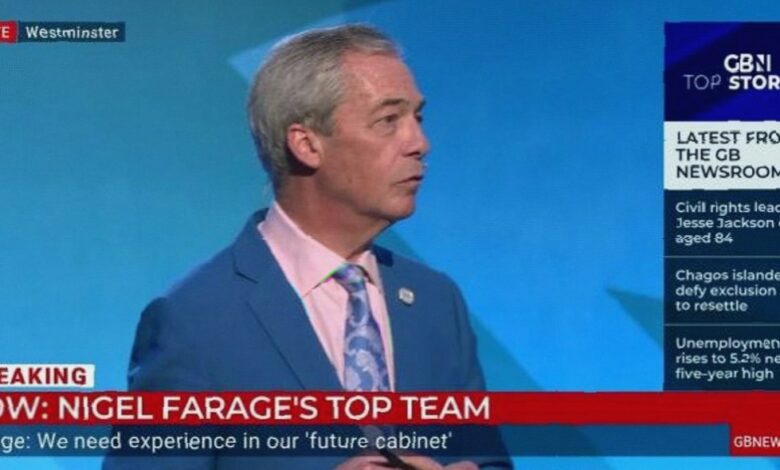
Reform UK has cemented its transition from a personality-driven protest movement into a formidable political institution, with leader Nigel Farage declaring the party has entered a “new phase” with an “established identity” no longer dependent on his personal appeal.
Addressing a press conference in Westminster, Mr Farage expressed pride that the party now possesses its own brand and a cadre of senior figures leading specific departments. “A year ago, you look at opinion polls and Farage’s popularity and the party’s popularity were two different things. There was a big gap between the two,” he said. “Now, if I was hit by a bus tomorrow, Reform has its own brand, Reform has its own identity, and now Reform has its own senior characters with their own departments to lead.” He assured that the initial phase of building the party, raising money, and raising its profile is now past.
From Brexit Party to ‘Brand New Conservative Movement’
This evolution marks a significant shift for the party, which was founded as the Brexit Party by Mr Farage and Catherine Blaiklock in 2018 before being renamed Reform UK in January 2021. Mr Farage stepped down as leader in March 2021, succeeded by Richard Tice, but resumed the leadership in June 2024. He has stated that Reform UK is becoming a “brand new Conservative movement.” The party’s ideology is described as right-wing populist with hard Euroscepticism, and it has also been labelled as far-right, radical right, neoliberal, right-wing nationalist, and national conservative.
A Shadow Cabinet and Tory Defections
In a clear signal of its governmental ambitions, Reform UK unveiled a “shadow cabinet” on 17 February 2026. Key appointments include former Conservative minister Robert Jenrick as ‘shadow chancellor’, Suella Braverman as spokesperson for education, skills, and equalities, and Richard Tice as deputy Prime Minister and spokesman for business, trade, and energy. Zia Yusuf was named ‘shadow home secretary’. The party has attracted several high-profile defectors from the Conservatives, including Lee Anderson, who became its first MP, along with Mr Jenrick, Andrew Rosindell, and Ms Braverman. Mr Farage has warned that disloyal individuals within his senior team will not remain with the party.
Electoral Surge and Polling Lead
Reform UK’s growing clout is reflected in its electoral performance. The party won five seats in the 2024 general election, marking its first entry into Parliament. In local elections in May 2025, it secured 677 seats and 31 percent of the vote, taking control of ten councils and two mayoral seats. By December 2025, it was polling at 27 percent support, ahead of the Labour Party.
Substantial Funding and Controversial Donors
The party’s expansion has been bankrolled by substantial donations. In the third quarter of 2025 alone, it received over £10 million, including a £9 million contribution from Christopher Harborne – one of the largest single donations in British political history. Since December 2019, approximately 92 percent of its donations have come from individuals and entities linked to fossil fuel interests, polluters, and climate science denial. Former leader Richard Tice has provided significant loans to the party. In the days following Mr Farage’s return as leader in June 2024, Reform UK raised £1.5 million, boosted by new members and larger donors including singer Holly Valance. Nick Candy serves as the party’s treasurer and has been instrumental in fundraising efforts.
Policy Platform: Immigration, Economy and Culture
Reform UK advocates a platform centred on reducing taxation, limiting immigration, opposing net-zero emissions policies, and substantially reducing public spending. It has pledged to deport over 650,000 adults it claims are illegally in Britain and to scrap indefinite leave to remain. Mr Farage has promised an “Illegal Migration (Mass Deportation) Bill” and vowed to end small boat migrant crossings within two weeks of taking power. The party’s manifesto has also focused on cultural issues, condemning “woke ideology” and seeking to ban the teaching of “transgender ideology” in schools. It has proposed policies to support pubs, including tax cuts and phasing out business rates for the sector.
Professionalising Operations and Local Power
Internally, the party is working to shed its “one-man band” image and professionalise its operations. It has hired staff from Conservative Campaign Headquarters for its media and candidate operations. As of December 2025, Reform UK has a significant presence in local government, controlling twelve councils. With a structured leadership team, clear policy directives, and robust financial and electoral support, the party positions itself as a permanent force in British politics, far removed from its origins as a vehicle for Mr Farage’s personal campaign.