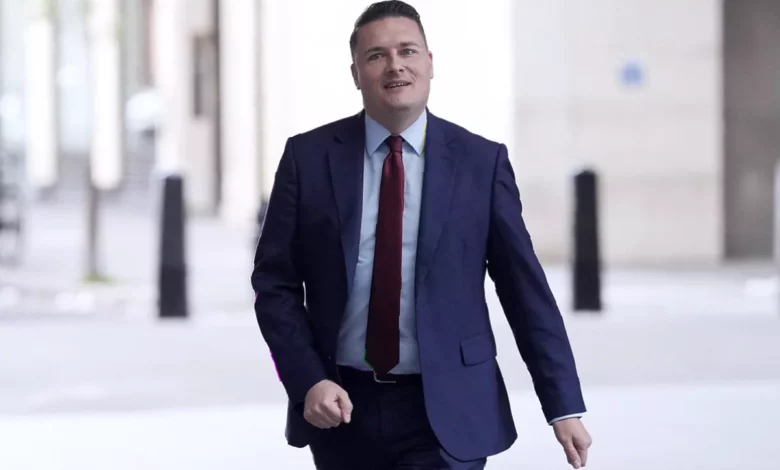
Health Secretary Wes Streeting has condemned Donald Trump’s recent rhetoric as “incendiary, provocative, outrageous” in some of the most direct criticism of the US President by a serving UK minister. The remarks, made on Sky News, came in response to the collapse of talks between Washington and Tehran and a stark warning from Trump that “an entire civilisation will die tonight” if Iran did not reopen the Strait of Hormuz.
Speaking to Trevor Phillips, Mr Streeting emphasised a crucial distinction in assessing the American leader. “I think we’ve all come to learn that you judge President Trump through what he does, not just what he says,” he stated, arguing that the reality of policy often diverged from the shock of the rhetoric.
The Health Secretary’s critique extended to the US President’s personal attacks on Prime Minister Keir Starmer, who Trump has compared to Neville Chamberlain while asserting “he is no Winston Churchill.” These historical analogies relate to Sir Keir’s firm stance that the UK would not be directly involved in the Iran conflict, which he has repeatedly stated is “not our war.” The Prime Minister has himself rejected Trump’s language, saying such words were “not words I would use – ever use – because I come at this with our British values and principles.”
Strains in the ‘special relationship’
Mr Streeting openly acknowledged that the UK-US alliance has been tested, citing specific policy rifts. Disagreements over the Iran war, alongside disputes concerning Greenland and the Chagos Islands, had “undoubtedly strained things with the Trump administration,” he said.
The Chagos Islands issue has proven particularly contentious. The UK government has been forced to shelve legislation to hand the archipelago to Mauritius following a lack of support from Washington; President Trump previously denounced the proposed deal as an act of “GREAT STUPIDITY.” Furthermore, in early 2026, Trump escalated tensions by threatening tariffs on several European nations, including the UK, if Denmark did not agree to a US purchase of Greenland. Though the tariff threats were later abandoned, the episode highlighted significant transatlantic friction.
Despite these strains, Mr Streeting sought to underscore the enduring partnership. “But on so many other things, our interests as the UK and the US are intertwined. We are old and close friends, and we’ve got a shared outlook as democratic countries, and we’ve got shared security interests,” he argued, framing the current difficulties as a challenge to be managed within a robust historical relationship. He also criticised domestic figures who aligned themselves with Trump’s initial aggressive posture on Iran, describing Reform UK leader Nigel Farage as a “plastic patriot” and attacking him and Conservative leader Kemi Badenoch for initially wanting to join the US President’s approach.
Defence plan pending as health spending protected
Turning to domestic priorities, the Health Secretary confirmed that the government’s long-awaited Defence Investment Plan would be published “shortly,” acknowledging it had already been delayed. He was adamant, however, that funding for any increase in military readiness would not come from his department’s budget. “I would not agree to money being redirected from health spending to defence to fund an increase to 3 per cent of GDP,” he told the BBC.
He contrasted the government’s approach with the “pie in the sky promises” of the previous Conservative administration, which had committed to raising defence spending to 2.5% of GDP, insisting Labour “do action, not words.” Mr Streeting stated the plan would be published “when it is ready, when it is robust, and it is a plan that can be delivered.”
The broader diplomatic context remains precarious. A fragile two-week ceasefire between the US and Iran announced on April 7 follows stalled negotiations in Islamabad, where US Vice President JD Vance said Iran’s refusal to commit to not building a nuclear weapon prevented a deal. On the continuing diplomatic efforts, Mr Streeting remarked, “As ever in diplomacy, you’re failing until you succeed.” His comments arrive amid ongoing, though subdued, speculation regarding his own future leadership prospects within a Labour party focused on navigating an unstable international landscape.