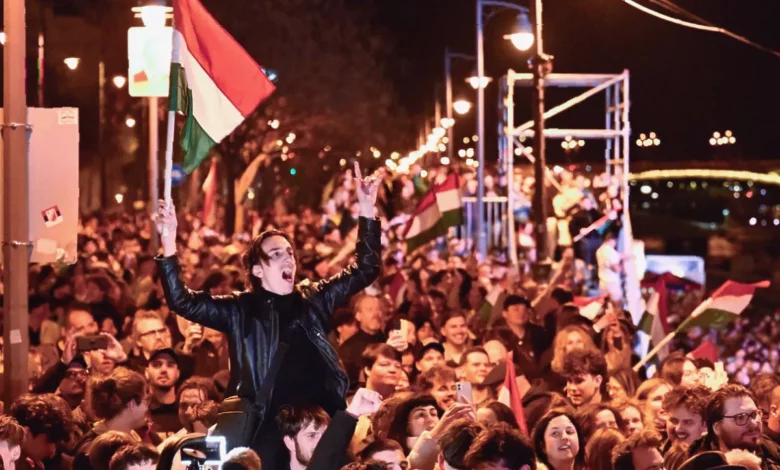
Hungary’s new prime minister, Péter Magyar, will mark the end of Viktor Orbán’s 16-year rule with an all-day “regime-change” celebration on Saturday, as thousands gather outside parliament to witness his swearing-in and usher in what he has promised will be a new era of accountability and European integration.
Magyar’s centre-right Tisza party swept to a landslide victory last month, winning 141 of the 199 seats in parliament — the largest majority any party has secured in Hungary’s post-Communist history. Voter turnout approached 79 percent, one of the highest in modern Hungarian elections, in a decisive rejection of the political and economic system built by Orbán. The 45-year-old lawyer, who formed Tisza in 2024 after leaving Orbán’s Fidesz party, is set to take his oath of office at around 3 p.m. local time in the neo-Gothic parliament building before addressing the crowd in Kossuth Square. “We will step through the gateway of regime change with a huge party. Come along, and invite your family and friends!” he wrote in a social media post on Sunday.
Recovering billions and holding officials to account
Among Magyar’s most urgent priorities is unlocking roughly €17 billion (about $20 billion) in European Union funds that were frozen during Orbán’s time in office over rule-of-law and corruption concerns. The money is desperately needed to revive an economy that has stagnated for four years, suffering technical recessions in 2023 and 2024, with GDP per capita stuck at 77 percent of the EU average and inflation reaching 17.1 percent in 2023 before falling back. Hungary’s economic model — reliant on foreign capital, exports and low labour costs — has exhausted its potential, according to analysts, and the suspension of EU funds has further hampered public investment.
But it is accountability that many of the nearly 3.4 million Hungarians who voted for Tisza expect above all. Magyar has vowed to create the National Asset Recovery and Protection Office, a new authority tasked with investigating and seeking to recover public funds misused during Orbán’s tenure. He has also pledged to join the European Public Prosecutor’s Office (EPPO), the EU’s anti-corruption watchdog, as part of a broader crackdown on what he argues is official corruption that has robbed Hungarians of economic opportunity. One of his first steps as prime minister will be to suspend the news services of Hungary’s public broadcaster, widely seen as a mouthpiece for Fidesz, until objectivity can be restored.
The incoming leader has nominated a cabinet of internationally recognised figures to restore competence to government. Anita Orbán — no relation to the outgoing prime minister — a lawyer, diplomat and business executive who served in the foreign ministry under Viktor Orbán but was marginalised by 2015 for her Atlanticist views and opposition to Russian energy dependence, will become foreign minister. She has emphasised strengthening ties with neighbouring countries, restoring relations within the Visegrád Group, and reducing Hungary’s reliance on Russian energy, which has increased since the invasion of Ukraine despite wider European efforts to diversify. István Kapitány, a former global executive at Shell, is set to become minister of economy and energy, with a focus on improving the business environment for small and medium-sized enterprises (SMEs), ensuring predictable policies, and reviewing guest worker regulations and subsidies for multinational companies. András Kármán, an economist with experience in the central bank and government who previously served as a state secretary under Orbán, will be finance minister. He has signalled that Hungary should aim to meet the economic criteria for adopting the euro within four years.
Magyar has also promised to restore Hungary’s place among Western democracies, repairing ties with EU partners that Orbán pushed to the breaking point. In a symbolic gesture, Tisza officials say the EU flag will once again fly on the parliament building’s facade from Saturday, after Orbán’s government removed it in 2014. Under Orbán, Hungary maintained friendly relations with Russia, continued to receive a significant portion of its oil and gas from Moscow, and frequently blocked EU sanctions packages against Russia and aid for Ukraine. The new government is expected to pivot decisively back towards Europe.
Tisza will conduct a major overhaul of Hungary’s governmental structure, creating separate ministries for health, environmental protection and education that did not exist under Orbán. The party’s manifesto, developed from a national questionnaire that received over one million responses, is dominated by an anti-corruption stance. Magyar, who comes from a family with legal traditions — his grandfather was a Supreme Court judge and his mother held high judicial office — has largely avoided divisive social issues, focusing instead on corruption and economic matters to avoid being drawn into “culture war” debates. He has also promised term limits for prime ministers, which would apply retrospectively to prevent Orbán’s return.
A ‘farewell to the system’
As the political transition unfolds, Budapest’s liberal mayor, Gergely Karácsony, has announced a separate “system-closing” party along the Danube River on Saturday, an event he says is meant to show gratitude to Hungarians who spent years speaking out against Orbán’s system. “Teachers fired, civilians and journalists humiliated, small churches torn apart,” he wrote in a social media post. “We can finally leave this era behind us — but first, let us remember the everyday heroes and express our gratitude with a farewell to the system.”