Downing Street has insisted the sovereignty of the Falkland Islands is “not in question” after reports emerged that the United States may review its diplomatic support for Britain’s claim to the territory as punishment for refusing to join US-Israeli strikes against Iran.
An internal Pentagon email, first reported by Reuters, set out options for the Trump administration to penalise Nato allies who did not grant the US access, basing and overflight rights for the war in Iran. One of the options listed is a reassessment of American diplomatic backing for European “imperial possessions”, explicitly naming the Falkland Islands. The memo also suggests suspending Spain from Nato.
UK firmly rejects the threat
The prime minister’s official spokesman said on Friday that “the Falkland Islands have overwhelmingly voted in favour of remaining a UK overseas territory, and we’ve always stood behind the islanders’ right to self-determination and the fact that sovereignty rests with the UK.” He added that Britain will not be “pressured on the Iran war”. When pressed on whether the UK could defend the islands, he described the question as “hypothetical”, stating: “That is not the situation we are in.”
The Pentagon memo: a detailed look
The leaked internal email lays bare the tensions between London and Washington that have mounted since the US and Israel launched coordinated military operations against Iran on 28 February 2026. Those strikes targeted nuclear facilities, military infrastructure and leadership, with a ceasefire taking effect on 8 April. Donald Trump has repeatedly attacked Nato allies, branding the alliance a “paper tiger” and threatening to withdraw altogether. He has singled out Sir Keir Starmer, saying the prime minister was “no Winston Churchill” after Britain initially refused a request to attack Iran from British bases.
Pentagon press secretary Kingsley Wilson confirmed the administration’s frustration. “As President Trump has said, despite everything that the United States has done for our Nato allies, they were not there for us,” she said. “The War Department will ensure that the president has credible options to ensure that our allies are no longer a paper tiger and instead do their part.”
Military and political reaction
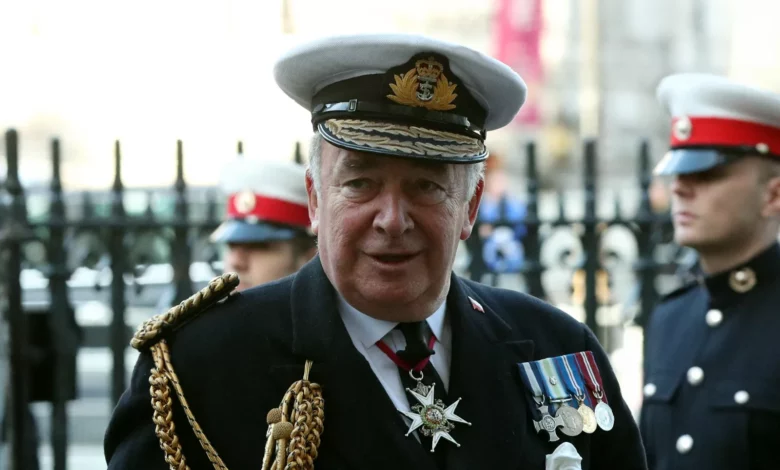
Admiral Lord West of Spithead, who commanded HMS Ardent during the Falklands War before the frigate was sunk with the loss of 22 crew, called the reports an “insult to the autonomous, self-reliant and free people of the Falkland Islands”. He added: “How dare they!” But the former Royal Navy commander-in-chief dismissed the military significance of any US move. “The recognition or otherwise by the US does not make the islands less secure,” he said, asserting that losing American support for British sovereignty would have “no impact”.
Tory leader Kemi Badenoch described the potential policy shift as “absolute nonsense” and compared it to Donald Trump’s previous threat to annex Greenland. “The Falkland Islands are British, they have been for a very long time. The sovereignty is British sovereignty,” she told broadcasters. “I don’t know what Donald Trump is talking about. This sounds like the sort of thing he was saying when it came to Greenland. I don’t think we need to take it that seriously just yet, we need to make sure that we are very determined in protecting British sovereign territory, and that includes the Falkland Islands as well as Chagos.”
How much of a real threat?
The core question is whether any US reassessment would actually change the realities on the ground. The Falkland Islands are a British Overseas Territory, administered by the UK since 1833, and their defence is provided entirely by Britain at RAF Mount Pleasant. Built in 1985 after the Falklands War and opened by the Duke of York, the permanent military base is operated solely by British forces and is not shared with the United States. Between 1,300 and 1,700 military and civilian personnel are stationed there at any one time, forming the hub of British military presence in the South Atlantic.
The islanders themselves have consistently voted overwhelmingly to remain British. A 2013 referendum saw 99.8% choose to stay a UK Overseas Territory. The sovereignty claim is also contested by Argentina, whose libertarian president, Javier Milei — a close Trump ally — has reiterated that Buenos Aires is doing “everything humanly possible to bring the Falkland Islands back into Argentine hands”. He has, however, ruled out the use of force, stating that the goal “must be done judiciously, it must be done with intelligence.” Argentina invaded the islands in 1982, triggering a ten-week war that cost 649 Argentine and 255 British military lives, as well as three Falkland Islanders, before Argentina surrendered.
Militarily, Admiral Lord West’s assessment that US recognition has “no impact” on the islands’ security carries weight because Britain already maintains a self-sufficient garrison at RAF Mount Pleasant. The Pentagon memo, meanwhile, does not propose military action against the territory; it targets diplomatic support. The question of US recognition in international forums — for example, at the United Nations — could theoretically complicate Britain’s position, but the UK government insists that sovereignty rests with itself and that the islanders’ right to self-determination is non-negotiable.
Spain, another Nato ally singled out in the memo for potential suspension, has also pushed back. Prime Minister Pedro Sánchez dismissed the threat, stating that Spain is a reliable member fulfilling its obligations. But the broader context is Trump’s open hostility toward the alliance. He has questioned whether the US should remain in Nato at all, asking: “Wouldn’t you if you were me?” The president has hit out repeatedly at allies since launching the Iran offensive, calling the alliance a “paper tiger” and accusing partners of failing to “do their part”.
The internal Pentagon email is described as an option-setting exercise, not a confirmed policy decision. But the fact that such options are being formally considered — including reassessing US backing for a longstanding British territory — underscores the depth of the rift. Downing Street’s message has been consistent: the Falklands are British, the islanders have chosen their future, and the UK will not be intimidated.