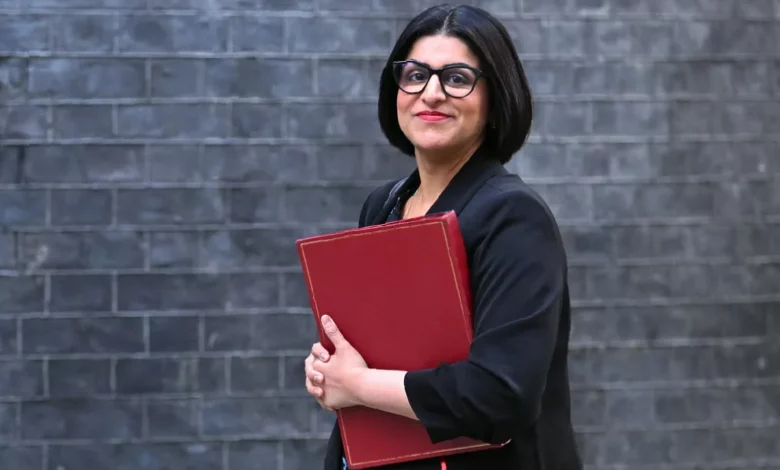
The government is considering opening talks with the Taliban to deport failed Afghan asylum seekers to Afghanistan for the first time since the fall of Kabul, the home secretary has signalled, in what would mark a significant reversal of existing policy.
Shabana Mahmood told reporters she was “monitoring very closely” discussions between European nations and the Taliban administration, and declined to rule out British involvement. “I’m not going to get into any additional discussions that are happening in government – we’ll have more to say about that in the future – but of course we monitor closely and we work with our partners in terms of the efforts that we all need to make collectively to try to get agreements,” she said.
Abdul Mateen Qani, a spokesperson for the Taliban’s interior ministry, has confirmed that discussions and meetings with British officials on the issue have already taken place in Kabul, stating that negotiations are ongoing and that British delegations occasionally visit the Afghan capital for talks, with further visits expected. The Taliban have said they welcome engagement and have not imposed conditions for accepting returning asylum seekers, rejecting any linkage to formal recognition or financial demands.
Afghan arrivals dominate small boat numbers
Afghans have become the most common nationality arriving in the UK via small boat, with 6,360 arrivals in the year ending June 2025 – an 18 per cent increase on the previous year. Between 2022 and 2024, approximately 29,600 Afghan nationals claimed asylum in the UK. So far this year, more than 6,000 migrants have crossed the Channel, down 36 per cent on the same period last year.
The grant rate for Afghan asylum seekers has collapsed. In 2023 it stood at 99 per cent, but following a higher standard of proof for refugee recognition introduced in 2024, the rate fell to 38 per cent in the first half of 2025 and to 34 per cent by the year ending December 2025. Rejected applicants who do not leave voluntarily remain in the UK without legal status.
Legal recognition barrier
The most significant obstacle to any deportation arrangement is that the UK does not recognise the Taliban administration as the legitimate government of Afghanistan. Without formal recognition, the government has no legal counterpart with which to negotiate removal agreements, issue travel documents or secure guarantees about the treatment of returnees. This stance has been consistent since the Taliban seized power in August 2021 and is shared by most Western governments.
Any move to enter into direct talks would therefore require a fundamental shift in diplomatic posture, even if it stops short of full recognition. The home secretary did not outline how the government might overcome this barrier, saying only that she was “not ruling it in or out” and would not provide a “running commentary” on internal discussions.
European partners are already exploring similar routes. The European Union is preparing to host a delegation of Taliban representatives in Brussels for talks on deporting Afghan nationals without legal status in the bloc, with discussions expected to cover flight logistics and conditions upon arrival. Germany has already deported more than 100 convicted criminals to Afghanistan since 2024. The UK government, Ms Mahmood said, is watching these developments closely.
The issue comes amid growing political pressure on the government to reduce migration, with the hard-right Reform UK party leading in opinion polls. As part of the crackdown, Ms Mahmood on Thursday signed a new three-year agreement with France worth £662m (€766m), which the government hopes will see French police patrols increased from 907 to 1,392 officers by 2029. Nearly a quarter of the UK funding is conditional on the effectiveness of the French measures.
Humanitarian warnings and legal challenges
Humanitarian organisations have strongly opposed any return of asylum seekers to Afghanistan. Last month the United Nations human rights office warned that the country had become a “graveyard for human rights”, describing “gender apartheid” enforced through torture and corporal punishment. Women and girls over the age of 11 are excluded from formal education, banned from most paid employment and effectively removed from public life. Since 2021, the Taliban have carried out 12 public executions. The UN High Commissioner for Human Rights has called on the Taliban to reverse these policies.
Human rights groups and UN officials have also raised concerns that returning individuals to Afghanistan could violate the principle of non-refoulement, which prohibits sending people to countries where they face serious risks to their safety or fundamental rights.
Meanwhile, the government is facing a High Court challenge over its failure to evacuate Afghans already approved for relocation. The case involves two individuals, referred to as FRY and BNM1 to protect their safety, who are challenging the Ministry of Defence over delays to their evacuation. In a hearing at the Royal Courts of Justice on Wednesday, Tim Owen KC, barrister for claimant FRY, told the judge that “on the face of it, it appears there is a freeze on relocations from Afghanistan”.
Resettlement schemes for Afghans – including the Afghan Relocations and Assistance Policy, the Afghan Citizens Resettlement Scheme and the Afghanistan Response Route – were closed to new applicants in July last year, just before a judge lifted an unprecedented MoD superinjunction used to conceal a serious data breach affecting nearly 19,000 Afghans who had applied for relocation. Around 35,700 people had received settlement under these three schemes by June 2025, with a total of 36,000 Afghans accepted through various relocation routes. Thousands of Afghan families remain housed in temporary hotels, some for more than 18 months.
Defence Secretary John Healey told parliament after the data breach was revealed that the government would honour invitations already made to “any named person still in Afghanistan and their immediate family”, adding: “When this nation makes a promise, we should keep it.” But a minister has recently indicated that support may now be limited only to those in third countries, and lawyers and caseworkers supporting Afghans in limbo say those found eligible for relocation are no longer being helped to flee the country.