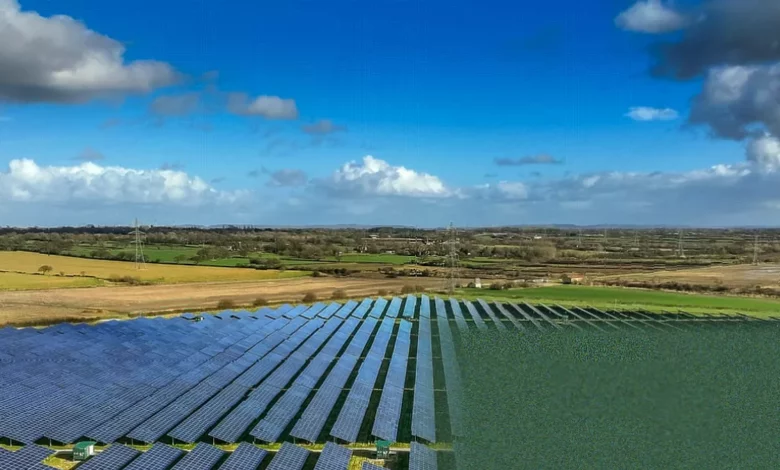
Britain’s solar power generation has surged to new, unprecedented heights this week, with the sun-drenched spring weather enabling back-to-back records for low-carbon electricity.
On Monday, solar farms across England, Wales, and Scotland fed 14.1 gigawatts (GW) into the national grid at lunchtime, eclipsing the previous high of 14GW set last July. That milestone was itself surpassed on Tuesday afternoon, as generation climbed to a fresh peak of 14.4GW. The electricity system operator confirmed the new highs.
Approval for UK’s Largest Solar Farm
This burst of solar productivity coincides with a major planning decision from ministers. The government has given the green light for the Springwell solar farm in Lincolnshire, which will be the UK’s largest once built.
Ministers said the decision built on their plan to “bring stability and lower bills in an uncertain world” by increasing homegrown low-carbon energy. The project is expected to generate enough electricity at its maximum capacity to power the equivalent of 180,000 homes a year.
The significance of the Springwell approval is amplified by its location. It comes just six months after the government backed the Tillbridge solar farm, another super-sized facility in Lincolnshire. The county is an area where Reform UK’s anti-renewables agenda has been gaining support, highlighting a political contrast between national energy strategy and some local sentiment.
Springwell represents the 25th large-scale clean energy project approved by the Labour government since it came to power in 2024. Collectively, these approved projects could generate enough power for the equivalent of up to 12.5 million homes.
Wind Drives Broader Grid Transition
The record solar output follows closely on the heels of a landmark moment for wind power. Towards the end of last month, windfarms generated a record 23.9GW, beating a previous December high and producing enough power for an estimated 23 million homes.
During that period of high wind output, gas-fired power generation was pushed to a two-year low, providing just 2.3% of the grid’s electricity. This served as a real-world test of the government’s plan to operate a virtually carbon-free grid by 2030.
The electricity system operator is understood to be preparing to run the grid without any gas-fired power for short periods as soon as this summer, which would be a first for the UK energy system.
Energy Minister Michael Shanks linked the drive for renewables to global instability, stating: “It is crucial we learn the lessons of the conflict in the Middle East – solar is one of the cheapest forms of power available and is how we get off the rollercoaster of international fossil fuel markets and secure our own energy independence.” He said the government was “driving further and faster for clean homegrown power that we control to protect the British people and bring down bills for good.”
Alongside backing large projects, the government has streamlined plans for “plug-in solar” and updated building standards to require solar panels on new homes from 2028.