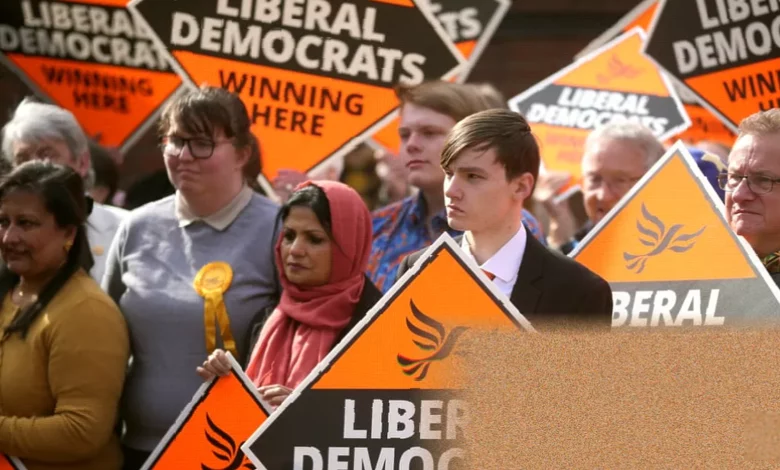
The Liberal Democrats could wake up on 8 May as the largest party in English local government, a prospect that would mark a remarkable climax to almost a decade of steady gains. Barring an unexpected reversal, the party is on course to increase its total number of councillors for an unprecedented eighth consecutive set of local elections. A particularly strong night, combined with heavy Conservative losses, would see the Lib Dems overtake Kemi Badenoch’s party. And if Labour fares very badly, there is an outside chance that second place could become first.
One party strategist described the trajectory in deliberate, unhurried terms: “It’s not something we’re necessarily expecting this time – it’s more likely in a year or two. But for all the fuss about Reform, year after year we are quietly making gains. It’s the tortoise and the hare.” The Lib Dems have already added more council seats than any other party over the last five years, gaining more than 750. In the 2024 local elections they finished second in the overall cycle for the first time since 2009, picking up 104 seats while Labour surged and the Conservatives lost 474.
Yet the party remains fifth in many national opinion polls, with a rating barely changed from the 2024 general election. Lib Dem insiders are sanguine, convinced that the political landscape is now so fractured and atomised that headline polling has become almost irrelevant. “A lot of people seem to be misreading the way things are going,” one senior Lib Dem said. “We think we have some of the answers.”
‘Electoral bamboo’ and the blue wall
Beyond the raw numbers, the party will measure success by two main gauges. The first is consolidation or progress in the so-called “blue wall” areas of southern England, where the Lib Dems captured dozens of parliamentary seats from the Conservatives in 2024. “In places like Surrey we want to show we can finish the job on the Tories,” one Lib Dem MP said. Another MP described the approach as “electoral bamboo – I’m still surrounded by Conservatives, but we are spreading out quickly.”
The second gauge is more uncertain: gains in councils that have historically been less promising ground for the party, such as Birmingham and Preston. In last year’s local elections the Lib Dems nearly doubled their seat count on Preston City Council, taking seats from the Conservatives to become the main opposition, and also secured a surprise win against Labour in one ward. It is in this second category that strategists hope to test a campaigning model built on rigorous voter targeting and the ability to “cut through the noise” of an increasingly fragmented political system.
The tactical voting gamble
The heart of the Liberal Democrat strategy, however, is a calculated bet on tactical voting driven by antipathy toward Reform UK. Internal polling suggests that roughly half of voters will do whatever is necessary to block Reform in their local area. “We are seeing huge, huge levels of tactical voting, in a way we haven’t seen before,” one senior Lib Dem said. This phenomenon is central not just to the local elections but to the party’s longer-term plan for the next general election, with 7 May serving as the first major test.
The party is running its biggest-ever programme of digital advertising, the bulk of it targeting Nigel Farage by contrasting his support for Donald Trump with Ed Davey’s repeated willingness to criticise the US president. These ads are paired with occasional Reform-adjacent retail policies, such as a demand to cut fuel duty by 10p to help with costs arising from the Iran war. “Iran has had real cut-through,” one Lib Dem MP said. “It’s not uncommon to have someone complain about potholes and then switch directly to the war and their worries about Trump.” The MP added: “It is also really notable the number of doors you knock on where people say they are desperate for anyone except Reform to win. Farage is really polarising.”
The party’s internal data divides the electorate into three broad camps. About a quarter of voters are seen as strongly pro-Reform – the “burn everything down and start again” sector, as one Lib Dem official put it. Another quarter are frustrated with the government and flatlining incomes, but uncertain where to turn. The remaining half, the Lib Dems believe, will vote tactically almost regardless. “We don’t need to chase the 50% who are already anti-Reform,” one senior Lib Dem said. “In 2019 we tried to win just with these people and got hammered. It’s easy to boost polling numbers and lose seats.”
Campaigning is therefore aimed at the uncertain quarter, using a mix of cost-of-living retail policies and an attempt to present Davey and his party as capable of understanding voters’ worries without the discord that comes with Reform. Reform’s support base, drawn disproportionately from older, male voters outside London and Scotland who previously backed the Conservatives, is motivated primarily by immigration, globalisation, Net Zero policies and big business. But the Lib Dems calculate that Farage’s closeness to Trump alienates many of those same voters, creating an opening for a party that can blend economic populism with a stable, non-disruptive image.
Local limits and larger lessons
This will, at most, be a partial test. Local elections are not general elections: turnout is typically between 30% and 40%, far lower than at a national contest, and many voters are less worried about a Reform-run council collecting their bins than they are about the idea of Farage in Downing Street. Still, there will be lessons to uncover. The Lib Dems will learn whether their electoral ground game still works in a five-party battle, and whether Davey – whose performance has prompted some grumblings among MPs – has the ambition and charisma to expand the party’s brand beyond its strongholds.
One MP sounded a cautiously hopeful note: “There is more work to do, but we are getting towards being on the right track. Some of the movement on economy is positive.” Yet the fragmentation that has created the Lib Dems’ opportunity also makes every prediction provisional. The two-party system has been smashed, voter loyalty is a memory, and smaller parties continue to proliferate. The Green Party has made its own gains, securing 74 net seats in the 2024 local elections while focusing on affordable housing. And newer forces such as Restore Britain, the Rupert Lowe-led start-up that sits to the right of Reform, are entering the field. “I knocked on a door and a man said he wanted to vote for Restore Britain,” one MP recalled. “When I told him they aren’t standing here he said: ‘Well, it’s probably you then.’ That was a first.”