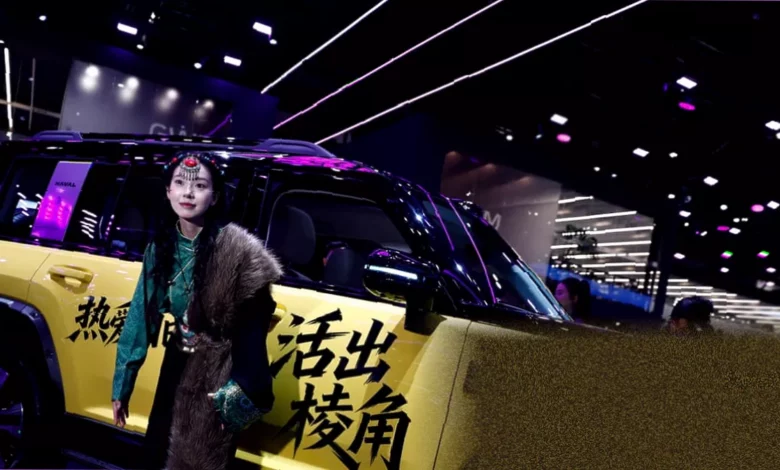
At the Beijing Auto Fair, a sprawling exhibition covering 380,000 square metres on the capital’s outskirts, China’s carmakers have made one thing clear: the future is no longer about simply selling more vehicles. With the domestic market saturated and sales slumping, the industry’s heavy hitters are pouring resources into the software and computing power needed to make autonomous driving a reality. The shift in focus was unmistakable at the world’s biggest car fair, where hundreds of manufacturers displayed more than 1,000 vehicles — and where the real story was what happens when drivers take their hands off the wheel.
The Race for Autonomous Driving
Huawei, the telecommunications giant, revealed this week that it plans to invest up to 80 billion yuan (£8.7 billion) over the next five years to develop its autonomous driving software and computing power. In 2026 alone, the company intends to allocate 18 billion yuan (£2.6 billion) to research and development in this area, aiming to outspend its rivals. Its Qiankun ADS platform has already logged more than 10 billion kilometres of autonomous driving and is used in over 50 models from 25 car brands, with 1.7 million vehicles delivered in China. Huawei is moving towards a full-stack supplier model, offering a “chip plus ADS full-stack solution” to carmakers.
The technological leap is not limited to one company. Xpeng, the electric vehicle maker, demonstrated its latest AI model that allows drivers to give the car natural-language commands — such as “park near the entrance to the shopping centre” — rather than selecting a specific spot on a map. The company’s Turing AI Intelligent Driving System is aiming for Level 4 autonomy, and its GX flagship SUV comes equipped with L4-ready autonomous hardware powered by proprietary Turing AI chips. Xpeng is also developing its own AI chips and platforms, including the Canghai Platform, and plans to produce hundreds to thousands of robotaxis in the near future, seeking global partners for widespread operation.
Xiaomi, better known for its phones and home appliances, has integrated its AI-powered operating system into its SU7 model. The system allows drivers to make restaurant reservations, compile notes while driving and place coffee orders. It can also detect when the driver appears stressed or agitated and adjust the cabin lighting and music accordingly. The vehicle runs on Xiaomi’s HyperOS software, designed for enhanced interconnectivity across devices.
A notable trend at the fair was the move towards mapless intelligent driving. Models such as the Li Auto L6 Max Edition, the Luxeed L6, and the Xiaomi SU7 Pro and Max versions demonstrated high-speed and urban full-scene Navigation on Autopilot (NOA), using artificial intelligence to navigate without relying on pre-loaded high-definition maps. Geely, through its ride-hailing arm Caocao, announced plans to deploy thousands of custom-designed driverless taxis globally, starting in 2027 with its purpose-built Eva Cab robotaxi. The company’s target is 100,000 robotaxis by 2030, positioning itself to compete with US firms such as Waymo, which have proven successful in San Francisco and Los Angeles.
Baidu’s Apollo Go robotaxi service remains a significant player in China’s autonomous driving landscape, having completed millions of rides across numerous cities. But its rollout has been hampered by regulatory barriers and technical setbacks. Last month, more than 100 Apollo Go robotaxis stalled simultaneously in the middle of the road in Wuhan, leaving riders stranded for hours due to a “system malfunction.” The incident has raised questions about the safety and reliability of large-scale autonomous operations.
Domestic Headwinds and Export Surge
The push into autonomous driving is driven in part by a brutal domestic market. Chinese car sales have fallen sharply in recent months: the number of passenger vehicles sold in the country dropped by 17% in the first three months of this year, as the government phased out a subsidy programme. BYD, the leader of China’s electric vehicle industry and widely seen as a bellwether for the sector, has reported seven consecutive months of declining sales.
“The fact that almost every automaker has some version of intelligent driving makes it different to almost any market in the world,” said Tu Le, the managing director of Sino Auto Insights, a consultancy. Le added that the Chinese market was so competitive that merely selling passenger vehicles domestically was no longer a viable way for companies to make money. Additional perks, such as leasing AI-powered software, are needed to boost revenues.
While domestic sales have slumped, exports have soared. China’s vehicle exports rose by more than 60% in the first quarter. The country’s largest car exporter, Chery, has set its sights on the UK market. Since launching in Britain in August 2025, it has become one of the country’s fastest-growing car brands, selling 13,500 cars between September 2025 and March 2026. By December 2025, Chery had secured a 1.09% market share in the UK. On Friday, the company announced a goal of 10 million global annual sales by 2030, up from 5 million in 2025. Farrell Hsu, the UK country director for Chery, said: “This exceptional growth underlines Chery UK’s position as a key contributor to the overall business growth by 2030.”
Chinese carmakers collectively captured nearly 10% of the UK’s new car market in 2025, accounting for approximately 200,000 vehicles, and 12.7% of UK electric vehicle sales. Industry professionals point to the UK’s relative openness: one source described the country as “culturally agnostic” about allowing Chinese EVs on its roads, unlike other nations that have blocked them on national security grounds. Faced with tariffs in big markets such as the US and the European Union, Chinese companies are increasingly focusing on the UK and Canada to shift units.
Global Ambitions and Regulatory Hurdles
The export drive is accompanied by ambitions to bring autonomous driving technology to foreign roads. Robotaxis have already been rolled out in several Chinese cities, but their widescale adoption has been limited by regulatory barriers as much as technical ones. Last week the Chinese government concluded a public consultation on a proposed new set of safety standards for autonomous cars. There are no nationwide guidelines, and Beijing has been cautious about allowing unfettered access for driverless cars on its streets. New proposed standards, expected to be implemented by July 1, 2027, will introduce mandatory safety requirements for L3 and L4 systems, replacing previous voluntary guidelines. These standards will cover technical and safety assurance requirements, including validation testing and data storage systems.
In the UK, the regulatory framework is evolving. The Automated Vehicles Act 2024 establishes a legal basis for self-driving vehicles, defining safety standards and placing liability on corporations rather than individual drivers. The government has confirmed that from spring 2026, commercial firms can pilot self-driving vehicles without a safety driver. Companies including Waymo, Uber and Lyft have announced partnerships with Baidu to use its self-driving software, and Chinese robotaxis are expected on the streets of London this year. Both China and the UK are also implementing marketing restrictions to prevent misleading claims about autonomous driving capabilities: China’s Ministry of Industry and Information Technology has reportedly banned the use of terms like “autonomous” and “self-driving” for driver-assist systems, while the UK held a public consultation in June 2025 to define protected terms.
Chery, for its part, launched its fourth brand in the UK in February. Hsu said the company was “actively considering options for production and R&D facilities in the UK.” Chinese companies are expected to account for one in every 10 new cars sold in Britain in 2025.