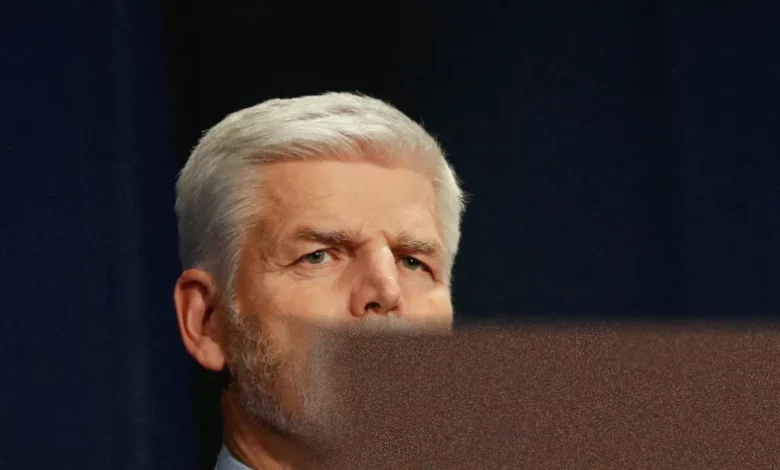
In a stark assessment from a seasoned military insider, Czech President Petr Pavel has declared that recent rhetoric from Donald Trump has inflicted more damage on the credibility of the NATO alliance than Russian President Vladimir Putin has managed in years. The warning from the retired NATO general and former Chair of the NATO Military Committee highlights profound unease within the alliance as it faces external threats and internal fractures.
Speaking at an event in Prague, President Pavel described Trump’s criticism of NATO over the Iran war as “unfair,” arguing it misunderstood the alliance’s foundational purpose. “NATO is a defence alliance built on deterrence and collective defence, and not an alliance that will automatically help in wars waged outside its territory,” Pavel stated. He revealed that European allies were not initially informed or asked for cooperation regarding the conflict, only later being asked to secure navigation in the Strait of Hormuz—a request that, when not met, led Trump to label the whole alliance a disappointment. “The moment we begin to question the alliance as a single, united entity, its role is lost,” Pavel warned.
EU Demands Answers from Hungary Over Alleged Coordination with Russia
As concerns over Western unity mount, a separate crisis is unfolding within the European Union, centring on Hungary’s relationship with Moscow. The European Commission has demanded an “urgent explanation” from Budapest after a leaked phone call between Hungarian Foreign Minister Péter Szijjártó and his Russian counterpart, Sergei Lavrov. In the recording, obtained by a consortium of investigative journalists, Szijjártó appeared to offer to send Lavrov an internal EU document related to Ukraine’s accession talks, stating: “I will send it to you. It’s not a problem.”
A Commission spokesperson said the recording raised “the alarming possibility of a member state coordinating with Russia, thus actively working against the security and the interests of the EU.” The allegations have triggered fierce rebukes from other member states. French Foreign Minister Jean-Noël Barrot accused Hungary of “betrayal of the solidarity required between countries of the European Union,” while Polish Prime Minister Donald Tusk called the revelations “really beyond shocking.”
The incident is seen as part of a wider pattern. Hungary, under Prime Minister Viktor Orbán, has consistently opposed Ukraine’s EU accession path and has delayed vital aid, currently blocking a €90 billion EU loan to Kyiv. Further leaked recordings reportedly suggest coordination with Moscow to obstruct Ukraine’s European integration. These actions have fuelled concerns that Orbán’s government is actively aligning with Russian interests, undermining collective EU foreign policy. The controversy erupts just days before a pivotal Hungarian parliamentary election, with polls suggesting a challenge to Orbán’s long tenure.
Orbán has rejected suggestions of proximity to Russia, telling a rally that “it was not the Russians, but the US vice-president who visited Hungary” in a reference to a recent endorsement visit from JD Vance. He argued that Hungary’s strongest anchor to the West was now the US Republican party, claiming traditional European sister parties had moved to the left.
🌍 @PM_ViktorOrban: Today our strongest anchor to the Western world is not our sister parties in Germany, but the Republicans in the United States of America. The US Vice-President's visit also refutes all the unfounded accusations that try to accuse us of Russian influence. It… pic.twitter.com/1EY1JDHisi
— Zoltan Kovacs (@zoltanspox) April 9, 2026
Trump’s NATO Criticism and the Greenland Question
The backdrop to President Pavel’s critique is a renewed wave of public criticism from Donald Trump aimed at the Atlantic alliance. Following a tense meeting with NATO Secretary General Mark Rutte, who admitted Trump was “clearly disappointed” with allies over the Iran war, Trump posted on social media: “NATO WASN’T THERE WHEN WE NEEDED THEM, AND THEY WON’T BE THERE IF WE NEED THEM AGAIN. REMEMBER GREENLAND, THAT BIG, POORLY RUN, PIECE OF ICE!!!”
This narrative is factually at odds with NATO’s history, as the alliance’s collective defence clause, Article 5, has been invoked only once—by the United States following the 9/11 attacks. Reports suggest the White House is considering a plan to punish NATO members deemed unhelpful during the Iran war, potentially by moving US troops out of countries like Spain and Germany. However, any move to withdraw from NATO would be constrained by a 2023 US law requiring congressional approval.
Trump’s mention of Greenland carries particular resonance in Denmark, which is in government formation talks after a recent election. The future of the largely autonomous Arctic territory remains a live issue. A newly elected Greenlandic pro-independence politician to the Danish parliament, Qarsoq Høegh-Dam, has stated the ultimate goal is full responsibility resting with the parliament in Nuuk, severing the need for representation in Copenhagen.
Amid these intersecting crises, President Pavel is himself embroiled in a dispute with the Czech foreign minister over who will represent the country at the upcoming NATO summit in Ankara in June, a reflection of ongoing tensions over foreign policy competences. His stark warning underscores a pivotal moment for an alliance grappling with challenges from both within and without.