British warships and military aircraft have foiled a Russian submarine operation that attempted to covertly survey vital undersea cables and pipelines in the North Atlantic, forcing the vessels to abandon their mission, the Defence Secretary has announced.
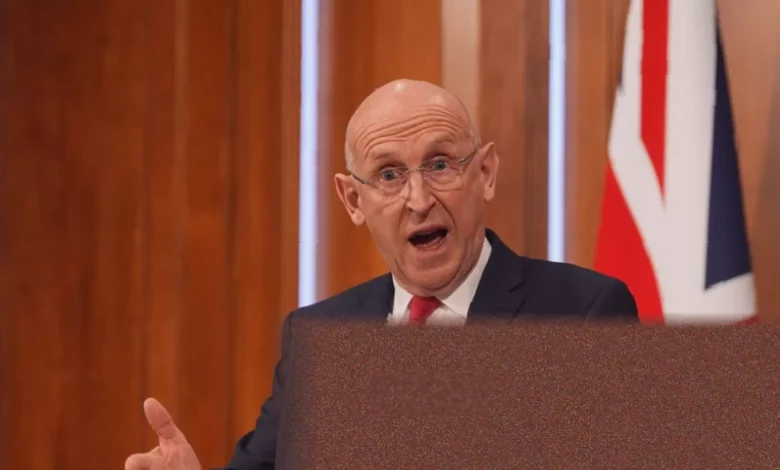
John Healey detailed a month-long operation involving more than 5,000 British personnel working with allies, which succeeded in tracking and exposing the Russian activity. He stated that the UK and its partners monitored every mile of the submarines’ route, recognising an Akula-class attack submarine as a likely decoy meant to distract from two more specialist submarines belonging to Russia’s secretive Main Directorate of Deep Sea Research, known as GUGI.
Operation exposed Russian ‘nefarious activity’
The Ministry of Defence said the Russian vessels were engaged in “nefarious activity near critical underwater infrastructure” and that the operation was conducted under the cover of events in the Middle East. The Royal Navy deployed the Type 23 frigate HMS St Albans, the replenishment tanker RFA Tidespring, and Merlin helicopters, working alongside RAF P8 Poseidon maritime patrol aircraft. Together, they tracked the submarines 24/7 across thousands of miles, deploying sonobuoys to monitor their movements.
“We watched the Gugi submarines as they spent time over critical infrastructure relevant to us and our allies in the North Atlantic,” said Mr Healey. “And because we were watching them, we wanted to ensure that we could warn them that their covert operation had been exposed and reduce the risk that they may attempt any action that could damage our pipelines or our cables.” He added that there was no evidence of any damage and that, with allies, the situation was now “verifiable”.
The silent threat to the world’s digital arteries
The incident underscores the acute vulnerability of the subsea fibre optic cables that form the backbone of the global economy. The MoD briefing notes that over 99% of international data traffic, including internet data and voice calls, travels through these cables, underpinning global banking, trade, and communications.
The Russian GUGI programme represents a persistent threat to this infrastructure. Described as a long-running military programme, GUGI develops capabilities to survey underwater installations during peacetime with the intent to damage or destroy them during conflict. Its primary objective is believed to be intelligence gathering and working with underwater installations, including the capability to eavesdrop on and sever undersea cables.
GUGI operates the world’s largest fleet of covert manned deep-sea vessels, including modified nuclear-powered submarines like the BS-64 Podmoskovye and the massive Oscar II-class K-329 Belgorod, which can carry smaller submarines and drones. This recent operation follows a pattern of increased Russian activity; the UK has seen a 30% rise in Russian vessels threatening UK waters over the last two years.
Last year, the GUGI spy ship Yantar was tracked near UK waters by a Royal Navy frigate and RAF P8s, with lasers being directed at British pilots. The Yantar is a specialist reconnaissance ship capable of mapping vital seabed infrastructure. In response to that incident, the UK changed its rules of engagement.
Mr Healey issued a direct warning: “We see your activity over our cables and our pipelines, and you should know that any attempt to damage them will not be tolerated and will have serious consequences. Our Armed Forces left them with no doubt that they were being monitored, that their movements were not covert as President Putin planned and that their attempted secret operations had been exposed.”
Green party sets out election goals
The defence announcement coincided with the launch of the Green Party’s campaign for the local elections, where its leader, Zack Polanski, set out the party’s aims and faced questions on policy.
Mr Polanski expressed confidence that the Greens would secure a “record breaking result”, beating the 241 new councillors gained in 2023. He attacked the national Labour government for a “toxic combination of chaos and cowardice”, citing housing as a key failure and accusing Labour-run councils of hypocrisy over renter’s rights and evictions.
On policy, Mr Polanski called for much tougher sanctions on Israel, including withdrawing the UK-Israel trade agreement, labelling the country a “rogue state”. He said all options, including arms embargoes, should be on the table, arguing that protecting human life outweighed economic cost. He also called for the UK to ban the US from using UK airspace and bases for operations in the Middle East.
Asked about NATO, he said the UK could not rely on an “unreliable” Donald Trump and should work more closely with European allies, advocating for a strategic defence review to consider threats from pandemics, cyber security, and food resilience. On domestic issues, he defended the principle of rent controls, criticised the building of unaffordable homes, and said the party was conducting due diligence on its expanded slate of candidates, though he acknowledged the “real challenge” of vetting and that “the odd candidate” who did not align with party values might get through.