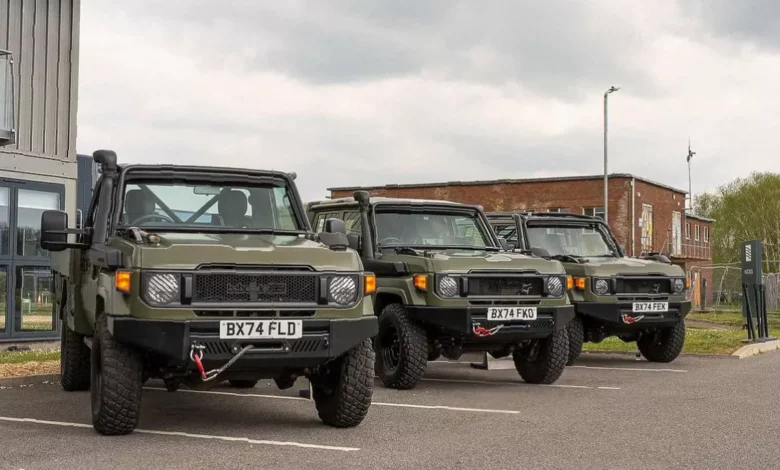
Babcock International and Toyota are developing a new military vehicle based on the Toyota Land Cruiser and Hilux platforms, intended to replace the British Army’s ageing Land Rover fleet. The proposed Babcock General Logistics Vehicle (GLV) is being positioned as the centrepiece of the Ministry of Defence’s Light Mobility Programme (LMP), a £2.2 billion initiative to modernise and rationalise the Army’s vehicle fleet over the next decade.
Military modifications and the role of UK SMEs
The GLV will not be a simple off-the-shelf conversion. Babcock’s facilities in the West Midlands will carry out extensive military-specific modifications, including armour provisions, communications integration, and tailored load configurations. These modifications are designed to meet the Army’s operational requirements while maintaining the durability and off-road capability for which the Land Cruiser and Hilux are globally renowned.
A network of UK small and medium-sized enterprises (SMEs) will supply the specialist components for the vehicle. Babcock recently hosted an engagement event at its Defence Battlelab in Dorset, bringing together around 30 suppliers to discuss the GLV’s technical requirements and to foster what the company describes as a “sovereign solution” – manufactured and modified entirely within the UK. The MoD has stipulated that at least 60% of the workshare must be handled by UK industry.
Chris Spicer, managing director for Babcock’s engineering and systems integration business, said: “The Army’s Land Rover has earned its retirement – and with the General Logistics Vehicle, we’re building on its legacy with a product which will provide soldiers with a tough, reliable and practical platform to support a wide range of mission-critical tasks.” He added that by working with the UK’s brightest SMEs, Babcock is “creating and sustaining high quality jobs within our supply chain and contributing to the UK’s defence dividend.”
The MoD’s Light Mobility Programme
The Light Mobility Programme is a broader MoD effort to replace legacy platforms and reduce the number of vehicle types across the Army. It includes categories for Light Mobility Vehicle (LMV), Light Protected Mobility (LPM), and Medium Protected Mobility (MPM). The LMV element specifically aims to replace the Land Rover and Pinzgauer vehicles, which are slated for retirement by 2030. The MoD issued a Request for Information (RFI) for the LMV platform in January 2025, with tendering expected to begin later in 2025 or 2026. The UK is seeking an “off-the-shelf” solution to ensure rapid fielding and minimise development costs, and Babcock’s proposal is among those competing. Other potential contenders have included offerings from General Dynamics Land Systems-UK and Ricardo (based on the Ford Ranger), and AM General.
The MoD has said the retirement of the Land Rover marks a “significant milestone” in the evolution of its mobility capabilities. Defence minister Luke Pollard commented: “The Land Rover and British Army share an incredible history and the image of a Landy in Army livery is truly iconic. As we look ahead to the future of light mobility vehicles, it is fitting to pay tribute to this extraordinary fleet that has served our Armed Forces so faithfully.” The first GLV vehicles are expected to be in the hands of soldiers by 2030.
The Land Rover’s seven decades of service
The British Army first acquired Land Rovers in 1949, and they have since been used in numerous conflicts and operations worldwide, including the Korean War, the Suez Crisis, the Falklands War, Bosnia, and Iraq. Last year, more than 5,000 Land Rovers remained in service across the UK military. Over the decades, several bespoke military models were developed, including the Series IIA Ambulance, designed to carry four stretchers and a medic; the Series IIA Pink Panther, used by the SAS for desert special operations and long-distance reconnaissance; the amphibious SIIA 109″, a prototype for sea landings; and the V8 Centaur Multi-Role Half-Track, which combined a road vehicle with a track taken from the Scorpion light tank. The Defender Wolf (XD) models also saw extensive service. Toyota vehicles such as the Hilux and Land Cruiser have themselves a long history of military use globally, including in the “Toyota War” during the Chadian-Libyan conflict in 1987, and have been favoured by special forces for their flexibility and ease of repair.