It is a song that captures a Mancunian boarding a train for London, full of ambition and a gnawing sense of ambivalence, and as Andy Burnham prepares to return to the House of Commons via the Makerfield by-election, the opening lines of The Smiths’ London might well echo in his mind. The line crooned by Morrissey — “And do you think you’ve made the right decision this time?” — hangs over a political career that has always been defined by reinvention and a restless search for purpose.
Burnham, whose love of the Manchester band is well known, has taken a circuitous route to this moment. Eleven years ago, in 2015, he was one of four candidates for the Labour leadership alongside Jeremy Corbyn, and chose to launch his campaign at the City of London headquarters of the auditing firm Ernst & Young. There he suggested he might back further benefit cuts and claimed that too many people associated Labour with “giving people who don’t want to help themselves an easy ride”. He later acknowledged that approach was the result of bad advice, describing it in 2022 as “tone-deaf” and “not authentic”.
His journey since then has been one of deepening certainty. First elected Mayor of Greater Manchester in 2017 with 63 per cent of the vote, he has been re-elected twice, in 2021 and 2024. His mayoralty has focused on homelessness, public transport and child sexual exploitation, and he has announced plans for a Greater Manchester baccalaureate as an alternative to university, aiming for it to be in place by 2030. Along the way he has engaged with pressure groups such as Compass and appeared on the Left Field stage at Glastonbury in 2022 and 2024, speaking about the housing crisis and the role of mayors in driving radical government. These appearances have helped him connect with crowds that most political figures leave cold.
The return to Westminster
Burnham is now the Labour candidate for the Makerfield by-election, triggered by the resignation of MP Josh Simons to allow him a route back to Parliament. The move has fuelled speculation that he may once again challenge for the Labour leadership, especially amid reported pressure on Keir Starmer’s position. If Burnham wins the by-election, he will be legally required to step down as mayor, triggering a mayoral by-election. Some observers give him only a 45 per cent chance of winning, but his pitch for power has already generated a level of ideological intensity that has been absent from Labour’s recent discourse.
Speaking this week at the Great North Investment Summit in Leeds, an event centred on devolution, he lamented a “draining away of economic, social and political power” from the north of England, compounded by “deregulation, privatisation and austerity”. He pointed to local economies whose wealth had been siphoned “into the hands of people for whom life was already very good” and noted the consequences: “people paying over the odds for the daily basics: energy, housing, water, transport”. He argued that for 40 years the country has been on the wrong path, and that people have lost all faith in politics.
Manchesterism and the productive state
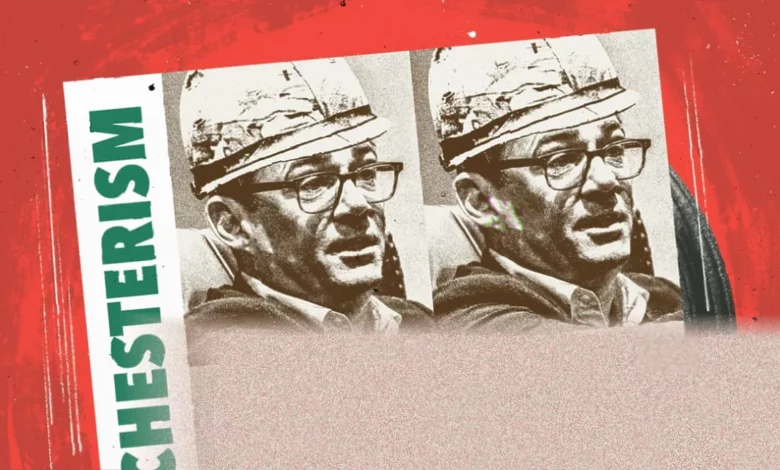
This critique forms the backbone of what Burnham calls “Manchesterism” — a work-in-progress credo that invokes the 19th-century Manchester School of free-trade liberalism while turning its meaning on its head. The modern version is a full-throated assault on neoliberalism. It begins with an account of history that emphasises deindustrialisation and the convulsions of the 1980s; Margaret Thatcher is referenced in the first 35 seconds of his first Makerfield campaign video, soundtracked by Elbow’s One Day Like This. There is a pointed emphasis on social housing and the argument that rising welfare bills signal economic and social failure, not national delinquency. The worst of modern capitalism, Burnham insists, is cynically extractive and socially damaging — shades of Ed Miliband’s old distinction between “predators” and “producers”. And by offering a specifically English critique of Westminster’s dysfunctional dominance, Manchesterism occupies ground that has so far been monopolised by Nigel Farage.
The core of the philosophy is what Mathew Lawrence, director of the think tank Common Wealth, calls “the productive state”. In a new book of the same name co-authored by Lawrence, the concept is defined in contrast to market coordination and welfare redistribution. “Where the market coordinates and the welfare state redistributes, the productive state produces: directly owning and operating capital in essential sectors, participating in markets as builder and provider rather than as regulator or redistributor,” Lawrence says. “It is the return of sovereign economic control of the economy’s foundations.” Burnham’s pledge to bring energy and utilities under “stronger public control” reflects this principle.
The Bee Network: rolling back the 1980s
The most visible expression of Manchesterism in practice is the Bee Network, Greater Manchester’s integrated transport system. The yellow buses, with their uniform £2 fare, have brought order and coordination to a public transport system that was torn apart by the Thatcher government’s deregulation of 1986. Greater Manchester became the first city-region in England to implement a bus franchising scheme under the Bus Services Act 2017, returning buses to public control. The network now covers buses, trams, cycling and walking routes, with commuter rail services to join by 2028. The £2 cap on adult single journeys and £5 cap on day tickets have already increased passenger numbers and improved reliability and affordability. Burnham frames this as “rolling back the 80s”, an explicit reversal of the deregulation that defined that decade.
Burnham’s Manchesterism also builds on the regeneration of Manchester itself, masterminded by former council leader Richard Leese and chief executive Howard Bernstein. They transformed a run-down city on the brink of collapse into one of Europe’s fastest-growing urban centres through a close public-private partnership. The city centre today is a mix of consumerist wonderment and a culture that is both entrepreneurial and collectivist. Burnham’s credo aims to extend that spirit to the whole country — though he is careful to note that Manchester is no progressive utopia, with rough sleepers in the shadow of expensive apartments and painful income and wealth gaps between the north and south of the conurbation.
Impact and resistance
Burnham’s radicalism appears to be shifting the terrain at the top of Labour. Chancellor Rachel Reeves has made a new commitment to a summer of cost-of-living activism, while Wes Streeting — once seen as a Blairite — has called for a “wealth tax that works”, proposing to equalise capital gains tax with income tax in a move he claims could raise £12 billion annually. The proposal has drawn criticism from within the party, with Chief Secretary to the Treasury Lucy Rigby arguing that wealth is already taxed.
Meanwhile, Burnham’s naysayers make sneering references to the gilt market and question how much his agenda would actually cost. Critics have labelled his interpretation of Manchesterism a “muddled melange of municipal meddling”, and Reform UK has framed the Makerfield by-election as a “David versus Goliath battle” against “Open Borders Burnham”. His candidacy was initially blocked by the Labour Party’s National Executive Committee for the Gorton and Denton by-election in February 2026 before being approved for Makerfield. The odds in Makerfield are finely balanced, and questions remain about how a Prime Minister Burnham would reorient Whitehall to deliver his agenda at speed. What is clear is that his ideas have injected a sense of ideological purpose and hope into a Labour party that risked becoming mired in technocratic management.