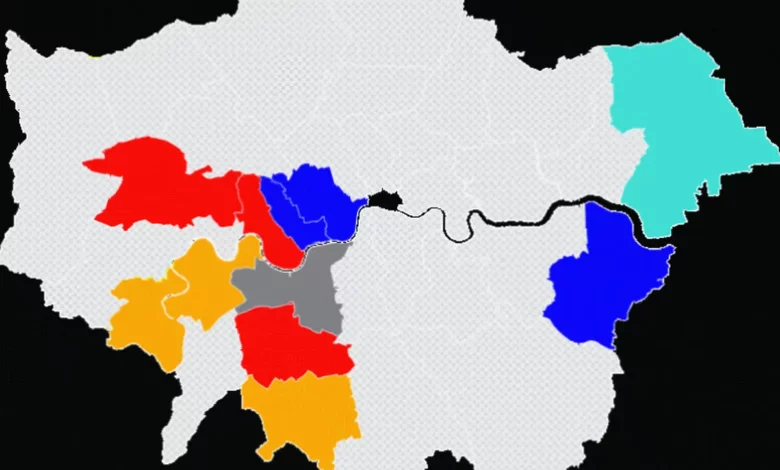
Reform UK has secured its first London borough council in Havering, winning 39 of the 55 seats and taking control from no overall authority in what the party’s leader, Nigel Farage, has described as a “truly historic shift in British politics.” The result marks a seismic breakthrough for the party, which officially rebranded from the Brexit Party in January 2021 and failed to win a single seat at the last London local elections in 2022.
Reform UK’s breakthrough in the capital
The party’s victory in the outer-east London borough was emphatic. Reform UK gained 36 seats compared with its zero showing four years ago, while the long-dominant Havering Residents’ Association collapsed from 15 seats to 14, Labour fell from eight to two, and the Conservatives – who previously held 14 seats – were wiped out entirely. Independent candidates also lost their single seat. The result means Reform UK now runs a London council for the first time, turning a borough that had been under no overall control into a stronghold for Nigel Farage’s party.
Elsewhere, Reform UK fell short of winning its top target, Bexley, where the Conservatives retained control. However, the party still picked up seven seats in Bexley (all formerly Conservative-held), reducing the Tory majority to 27 seats, with Labour on seven and five seats still to be declared. The party is also hoping to make gains in Bromley, where the count continues. In Sutton, Reform UK won two council seats – a first for the party in that borough – as the Liberal Democrats consolidated their grip. Analysts project that Reform UK could win around 1,580 council seats nationally, placing it well ahead of other parties in terms of seat gains, and Farage has said the results herald a “historic change in British politics”, claiming “there is no more left-right.”
The rise of Reform UK has come largely at the expense of the Conservatives in outer London, but the party is also challenging Labour in its traditional heartlands. In Barking and Dagenham – the only London borough to have remained under Labour majority control since its creation – Reform UK is within five points of overtaking the Tories, according to projections.
Labour on the defensive
Labour entered the 2026 London borough elections as the defending party in 21 of the 32 councils, having won that many at the last contest in 2022 when most wards were a straight fight between two mainstream parties. But the party has faced a multi-front assault, with projections suggesting it could lose more than 600 seats across the capital – possibly exceeding 1,000 – as voters defect to the Greens in inner London, the Liberal Democrats in boroughs such as Merton and Southwark, the Conservatives in former strongholds like Westminster and Wandsworth, and Reform UK in outer areas.
The most symbolic loss for Labour came in Westminster, where the Conservatives regained control, taking 32 seats to Labour’s 22 – a net gain of eight for the Tories. In Wandsworth, a flagship Labour council since 2022, the party lost overall control. The Conservatives won 29 seats there (up eight), Labour dropped to 28 (down six), and one independent held their seat, leaving the council under no overall control. Labour held on in several inner London boroughs but with reduced majorities: in Ealing, the party won 46 seats (down ten); in Merton, it held with 32 seats (up two) despite a strong Liberal Democrat challenge; and in Hammersmith & Fulham, Labour retained 38 seats (up one). In Havering, Labour’s representation shrank to just two seats. In Bexley, Labour lost three seats to end on seven.
The party also faced headwinds in the mayoral contests held in five boroughs. In Tower Hamlets, Labour suffered a significant defeat in 2022 and has not regained control; the independent left-wing Aspire party, led by incumbent mayor Lutfur Rahman – who previously held the post, was removed after electoral malpractice allegations (which he denied), and returned in 2022 – is seeking re-election. In Hackney, Labour’s Caroline Woodley is seeking her first borough-wide mandate, but faces a strong challenge from the Green Party’s Zoë Garbett. In Croydon, the incumbent Conservative mayor Jason Perry is fighting to hold off Labour’s Rowenna Davis, Liberal Democrat Richard Howard, Green Peter Underwood, and Reform UK’s Ben Flook. In Lewisham, Labour is defending the mayoralty under a first-past-the-post system (replacing the supplementary vote used previously), with the Greens and Liberal Democrats as significant contenders. In Newham, Labour is being challenged by the Greens and the Newham Independents Party.
Wider election picture: multi-party politics and hung councils
The 2026 London local elections are widely regarded as producing the biggest change in local authority control in two decades, with the traditional two-party system fragmenting into a multi-party landscape. Five parties – Labour, Conservatives, Liberal Democrats, Greens, and Reform UK – are now seriously contesting different parts of the capital, a trend reinforced by independent and micro-party candidates, notably “pro-Gaza independents” who have gained traction in areas with significant Muslim populations such as Newham, Islington, Haringey, and Redbridge.
The Liberal Democrats consolidated their strongholds. In Richmond upon Thames, they won all 54 seats, gaining five from the Greens (who were left with none). In Sutton, the Lib Dems secured 51 seats – a gain of 23 – while the Conservatives were wiped out, falling from 20 seats to zero. The party also made incremental gains in Merton, where it now holds 19 seats (up two). The Greens, meanwhile, emerged as a formidable force in inner London, particularly in Hackney, Lambeth, and Camden, where they are expected to become the largest party on multiple councils. Polling indicates 45% of 18-to-24-year-olds would vote Green, underscoring the party’s appeal among younger voters.
The Conservatives held several councils, including Kensington and Chelsea (34 seats, down two) and Bexley (27 seats, down four), but fell to historic lows in some areas. They regained Westminster but lost Wandsworth to no overall control and shed seats across the capital. A significant number of councils are now under no overall control, including Wandsworth, and further hung councils are expected across London, leading to coalition or minority administrations.
The elections were marked by a climate of abuse, according to election monitors, and the campaigns were heavily influenced by national political sentiment – including dissatisfaction with the Labour government, the ongoing conflict in Gaza, and “culture wars” – as well as local issues such as the cost of living, housing, environmental policy, bin strikes, and the impact of local government reorganisation. Voter turnout was high, with millions of Londoners casting ballots across the 32 boroughs to elect 1,817 councillors and five directly elected mayors.