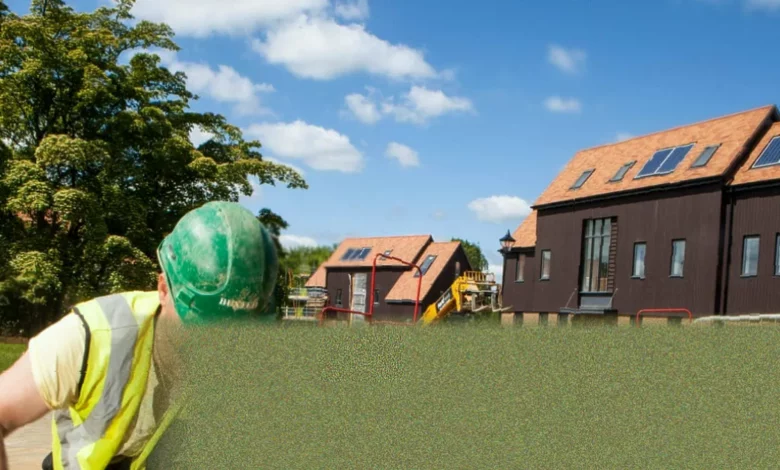
The UK’s largest housebuilder, Barratt Redrow, is scaling back its investment in new land, citing a “less certain backdrop” created by global geopolitical instability, a move that casts further doubt on the government’s flagship pledge to build 1.5 million new homes in England.
The company confirmed it now expects to buy between 7,000 and 9,000 plots, a reduction from its previous target of 10,000 to 12,000. In financial terms, this represents a cut of roughly £100 million from an £800m-£900m land acquisition budget. This disciplined pullback follows an even more drastic move from the London-focused Berkeley Group, which announced a complete halt to new land purchases due to what it called “unprecedented” increases in costs and regulation, alongside weak buyer demand.
Targets Slip as Builders Retreat
This corporate caution arrives at a critical juncture for the government’s housing ambitions. Official figures show that in the financial year 2024-25, England added a net 208,600 dwellings—a 6% decrease on the previous year and massively short of the annual 300,000 average required to hit the 1.5 million target by August 2029. Estimates suggest that only about 20.6% of the target had been met by early 2026, indicating it could take nearly six more years at the current pace.
While Barratt reported “solid” recent trading and still expects to complete between 17,200 and 17,800 homes this financial year, its profit forecast of around £570 million underscores that this is a strategic retreat in the face of market headwinds, not a crisis of survival.
The Squeeze: Rates, Energy and Rising Costs
The decision by major developers is a logical response to a perfect storm of economic pressures. The most fundamental shift is in the cost of borrowing. The prospect of interest rates remaining higher for longer, influenced by global uncertainty, means mortgage rates are expected to stabilise between 4% and 5%, a level that continues to strain affordability for potential buyers and dampen demand.
Compounding this is a severe cost inflation crisis within construction. The conflict in the Middle East has driven soaring energy prices, which Barratt warns will feed into increased building material costs as far out as 2026-27. This comes on top of already steep inflation; the Construction Products Association reported a 26% increase in building material costs in the year to July 2025.
Housebuilders also point to a growing regulatory and tax burden. Berkeley Group specifically cited a “continuous increase” in this burden and delays from the Building Safety Regulator. All developers face the Residential Property Developer Tax (RPDT), a 4% levy on profits exceeding an annual £25 million allowance, introduced as part of the government’s Building Safety Package to fund cladding remediation.
Planning Reform and the Push for Help
In response to the slowdown, the government has embarked on what it describes as the biggest rewrite of planning rules in over a decade, aiming to accelerate building by encouraging development around transport hubs and in urban centres. While these supply-side reforms have been welcomed as more effective than previous efforts, turning local plans into actual homes takes time—a luxury the government’s strict electoral timetable does not afford.
Consequently, the industry is lobbying hard for a revival of demand-side support, specifically a new “Help to Buy”-style equity loan scheme targeted at first-time buyers, to which housebuilders would contribute. The original scheme, introduced by former Chancellor George Osborne, facilitated over 387,000 purchases between 2013 and 2023, though analysis suggests it disproportionately benefited higher-income households.
The Treasury, however, is said to fear the inflationary effects of such a intervention, making its adoption within the next 18 months appear unlikely. This leaves the government in a bind: its planning reforms may bear fruit in the longer term, but the immediate pressures of interest rates, energy costs, and weak demand—exacerbated by global instability and supply chain disruptions—are creating a powerful brake on development. The construction sector’s downturn, marked by 15 consecutive months of contraction in the S&P Global UK construction PMI as of March 2026, with residential work falling steeply, underscores the scale of the challenge.